Saturday, May 19, 2012

Atonement at Ground Zero


From the winter of 2010 through the spring of 2012, I worked on a book that is now titled Atonement at Ground Zero: Revisiting the Epicenter of Faith (Wipf and Stock, 2012). It just hit the publisher's catalog yesterday, and should be on Amazon and Barnes & Noble soon.

I wrote this book in an effort to struggle with the question, Why did Jesus die? There is much to found in our various doctrinal grids to attempt to answer that question theologically, but what happens when you attempt to press back to the ground zero of the events surrounding Jesus' death? Would the witnesses to his execution agree with our theological interpretations?

So in Atonement at Ground Zero I look back at the New Testament to help us imagine and hear the responses of the various witnesses. Through Jesus' friends and family, the community of Israel, the Romans, and through Jesus himself, we discover an interesting and surprising weave of experiences and expectations.

My hope is that this is a book that joins in with other (more qualified) voices that want to expand rather than restrict the doctrine of the atonement, but also that it will be a book that helps us communicate the richness of what God has done in Jesus Christ for the sake of the world. So it becomes, in essence, a preaching book that seeks to help others to embrace and speak of new images that lead people into the expansive mystery of God's love for the world.

My desire is that it would help followers of Jesus—-pastors, leaders, and others who care about communicating the good news of Jesus Christ--to find new language that launches from the old, and to learn to employ new images that mean as much to our culture as the former ones did in cultures now long past.

Tuesday, May 15, 2012

Is Jesus Reckless?

In reading Luke chapter nine this morning, I was struck by the way Jesus seemed to play a bit fast and loose with the qualifications for joining him in his work. We know that the twelve disciples were pretty sketchy in their understanding of who Jesus was and what he was up to, yet they were sent out in his authority to proclaim the good news of the kingdom, to heal the sick, and to cast out demons. And Jesus sent them out unsupervised!

On top of that, when he was told that someone was out there casting out demons but not as part of the group of disciples, Jesus told his friends that it was okay: If a person isn’t against you, he says, then consider yourselves on the same team.

But what if (I am thinking to myself) that other person doesn’t think rightly about things we consider to be important? James might be wondering, “What if that person thinks that Samaritans are just as good as Jews?” John might ask, “What if that person is like the Sadducees, and doesn’t believe in the resurrection of the dead?” Peter could be asking, “But what if that person hasn’t given up everything like we have?”

If the disciples were to have asked Jesus these kinds of questions, there’s a good chance he would have answered them like he answered Peter much later, described in John 21:22:

“What is that to you? Follow me.”

I wonder if, today, Jesus wanders through the halls of power, up and down the grimy streets of the city, along the corridors of the prisons and the sanctuaries, seeing people acting out their dramas as ones who are sometimes for him and sometimes against him. In those places of turmoil and intrigue, does he continue to whisper the same words over and over to all the broken and misguided people he encounters?

“Come, follow me.”

And when we who call ourselves faithful describe who is in and who is out, whose political posturing constitutes good or evil, whose doctrinal declarations are truthful or heretical, whose worship practices are valid or invalid, does Jesus continue to say to us,

“What is that to you? Follow me.”

Monday, May 7, 2012

Same-Sex Marriage and the Lost Love Between Church and State


The topic of same-sex marriage is still causing a stir in the US, from the White House to every state in the Union to just about every church in every city. It’s a subject that cannot be dodged.

According to this morning’s CNN article, almost of half of US citizens are open to the idea of gay marriage, and even more are fine with the idea of civil unions. When you break down the polls by religious affiliations, the numbers are mixed, with Roman Catholics being considerably more open to gay marriage than are Evangelical Protestants.

I think there might be something important going on here, and I believe it may transcend the arguments about the sanctity of marriage (being evidenced by how the government defines and affirms marriage). Here’s a text of Scripture to consider on the matter:

“. . . if anyone wants to sue you and take your coat, give your cloak as well.” (Matthew 5:40)

These are the words of Jesus in the Sermon on the Mount. The context is about how his followers are to respond when confronted by an “evil doer” (v. 39). Many today would say that those advocating for gay marriage are well within the ranks of the evil doers. Whether or not that is the case, there is, I think, something to consider here.

We have been sued for our coat—the defining of marriage as a union between one man and one woman.

Perhaps we will have to also give up our cloak—our partnership with the state in defining, affirming, and establishing marriage. Think about it:

•Some churches would be uncomfortable (at the least) with a co-habiting, unmarried couple in their midst, but would not typically raise a concern if the couple had obtained a legal marriage license (at City Hall, in Las Vegas, or wherever) prior to applying for membership.

•There is a distinct partnership between church and state in a marriage ceremony. I have officiated at a number of weddings, and when I pronounce the couple “husband and wife,” they are married, and the government takes my word for it. However, if the county recorder’s office doesn’t receive the signed marriage license in due time, there will be no recognizable marriage for that couple, either by the state or by the church.

Let’s face it: The church in the US has been holding hands with the government when it comes to marriage for a very long time. It has been an unquestioned and comfortable partnership because we have operated under the perception that we share a common interest when it comes to marriage. The problem is that we don’t have matching agendas when it comes to marriage. The government affirms marriage because it offers the possibility of safety and stability for the raising up of families (and future citizens), and creates legal boundaries for property rights, child custody, and so on. But the church typically affirms marriage for different reasons. For the church, marriage has something to do with reflecting the image of God and creating nurturing environments for human beings.

The push toward same-sex marriage is clearly deconstructing the concept of marriage as it has traditionally been known. So perhaps the government needs to drop the word entirely and simply grant “civil unions” to any two human beings who qualify for such unions (marriage—even traditional ones—are not rights as people currently claim. Not everyone has the right to get married. You can’t get married to someone if you are already married to another; you can’t get married if you are not of a certain age; etc.). If the government decides that such unions serve the self-interests of the nation, and if sufficient popular (read: voting) support leans that direction, then it will happen, regardless of the label put upon them.

So where does that leave Christian communities? What would happen to us if we separated the sanctity of marriage from the legality of the state? Would marriage really die, or would it be reborn? We might have to consider giving to Caesar what is Caesar’s, and to God what is God’s. And very likely, we will have no choice.


Thursday, May 3, 2012

Christianity and Angry Critics


I’ve been reading various blog comments regarding Christianity on a number of sites. I find myself perplexed and bothered by the vitriolic responses by some non-religious folks who find the Christian faith to be stupid, violent, evil, repulsive, and dangerous (one commenter even offered the hope that a certain high-profile TV preacher would be “taken out” by some disillusioned parishioner).

One thing I notice is that much of the angry comments are crafted around a lot of popular distortions of Christian faith—including some distortions maintained by Christians themselves. On occasion I read critiques against Christians by atheists and am somewhat disturbed that I don’t entirely disagree with them.

It is rare to see a religious skeptic taking issue with legitimate biblical scholars or theologians. The kind of reasonable reflection that comes from some of those Christians in the academic world is not typically the fuel that lights up the commentator’s fires. Most of the attack is on popular religion and too much of it reeks of deep hatred and even violence.

I worry about this. I don’t mind that some people find Christians to be irrelevant or mistaken—that’s been going on for a couple of thousand years. But I am concerned when the blogosphere carries comments and declarations suggesting that a purging of Christianity from society would be the balm that soothes the wounds of the nation (although people like the Emperor Nero and Adolf Hitler thought the same thing).

I wonder if there aren’t two things going on here:

1. Through the angry words of the critics, should we who follow Jesus take an honest look at ourselves and see if the critiques are, in any way, warranted? Is it possible that God could be speaking through some of the more thoughtful critics, and even through the ones who are rageful?

2. Could much of the anger that we hear be grounded in the perception that Christianity—at least in America—is not so much a description of the movement of faithful people who follow Jesus, but instead is a dominant political and social force that is viewed as an oppressor of freedom? Is the fury that we witness a tool for unseating the perceived power of Christendom?

This is disturbing stuff and we ignore it to our peril. Strategizing ways to retain or gain power is not, in my view, the answer. But I think the answer might be found in revisiting our identity as followers of the humble king who “came not to be served, but to serve, and to give his life a ransom for many” (Mark 10:45). We may truly end up being pushed to the margins of society (as has happened elsewhere in the history of the world), but it may be that we meet Jesus anew at those places at the edge.

Wednesday, May 2, 2012

Rachel Held Evans and her V-Victory


Rachel Held Evans’ recent campaign to get her publisher to allow the word vagina to remain in her upcoming book was not only funny, but also successful. She correctly describes the concerns and fears of editors and publishers that the use of certain words will offend their popular Christian readership and diminish book sales. Rachel rightly calls for that to change.

But it probably won’t, at least not anytime soon. Publishers of popular Christian books seem to view their audience as ones who don’t want to read things that go too deep, ask too many uncomfortable questions, contain violence, or use offensive language. A visit to one of the few remaining Christian bookstores will offer evidence of the literary Pablum that people seem to want to slurp.

However, I don’t think our publishing friends give their audiences enough credit. I’m not saying that everything has to be heavy-duty academic stuff, but the history of Christianity is hardly bereft of weighty writings or scandalous stories. The first three hundred years of the church alone produced volumes of serious theological thought that still line the shelves of academicians today.

There are popular speakers who add to this illusion. I heard the popular writer Donald Miller (whose first book, Blue Like Jazz, I loved) speak recently and he spent a great deal of time telling people that scholarship was dispensable when it came to being a follower of Jesus. I suspect he was trying to say that lack of theological credentials shouldn’t disqualify a person from being a disciple, but it didn’t come off that way. I’m concerned about how people heard his message. It suggested an anti-intellectualism that isn't helpful to any of us.

As far as scandalous material goes, it’s a good thing that current Christian publishers didn’t have a hand in determining what went into the Bible. Otherwise they might have sanitized

•Jael pounding a tent stake through Sisera’s head (Judges 4)

•Onan terminating intercourse and spilling his semen on the ground (Genesis 38)

•The gang-rape and dismemberment of a woman (Judges 19)

•All kinds of steamy sex talk (Song of Solomon)

You get the idea. Using language gratuitously in order to sell books is no better than sanitizing language for the same reason. But I would hope that some brave editors and publishers would push the envelope a bit and see if their audiences would rise to the occasion. Authenticity, intelligence, and artful use of language are good things.

So, hurray for Rachel and her vagina victory.

Tuesday, May 1, 2012

Theology and Vampires


Later this month—May 17-19, to be precise—my collection of short stories, Dark Ocean, will be available as a free download through Amazon. A special bonus at the back of the book offers a few chapters from a previous novel, This Side of Death.

This Side of Death is a horror story. It involves vampires. I should probably explain why I like to write theological-type things and also creepy, spooky stories. Both my mother and my wife have their own explanations for my behavior, but I don’t buy into the whole demonic possession thing.

I started writing This Side of Death a few years ago because my grandchildren were reading the Twilight series and trying to convince me that vampires were not evil, but were actually a misunderstood and marginalized race of beings. I set out to show my descendants the truth about the undead.

But the story sort of got away from me and I discovered that it was fertile ground for exploring questions of faith. In This Side of Death, a family has suffered the loss of their husband and father, a good man who died a horrible and violent death. The son, Jay, drifts from anger to disillusionment to a deep sense of responsibility. His sister, Vickie, mostly stays in the anger mode.

They are drawn into a story of violence and horror, seeking to answer the question, What is hell? For them, hell has come to visit them on earth. Vickie declares that God himself should be banished there after what he allowed to happen to their father. A local priest, who keeps appearing at the margins of the family’s life, speaks pastorally to them and offers a way of thinking about life and God that they have not yet considered.

This story will end up being a trilogy. The second book, Morana, should be out this year (if my copyeditor will quit having a life of her own and do what I demand!) and the third is in process. Anglican priests keep popping up in the story, sometimes as key characters. They provide the theological and ethical voices of the stories. In This Side of Death, they offer a perspective on the nature of evil; in Morana they actively confront social injustice that appears in the form of human trafficking, a horror that is orchestrated by—you guessed it—another vampire.

Fiction—especially creepy fiction—is a great way, I believe, to hash out theological ideas. Characters get to wrestle with their doubts and fears in ways that are not always permitted in Christian non-fiction (nevermind that most Christian publishers won’t publish the kind of fictional trash that I write).

The one who used fiction as a theological vehicle better than anyone in the world was Jesus. His parables tell stories that offer characters that walk out the implications of his teachings. The characters don’t always fare well, and sometimes suffer great pain. But the stories make the point, don’t they?

Sunday, April 29, 2012

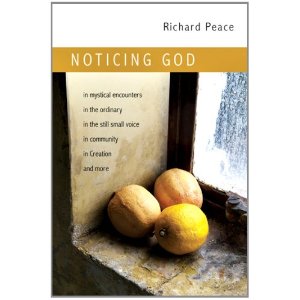
A Refreshing Invitation to the Presence of God


Just this morning I finished Dr. Richard Peace's new book, Noticing God. Here is my review.

The title of this book--Noticing God--suggests something astonishing to the average reader: That God is everywhere, and noticing him is a possibility.

Dr. Richard Peace takes a slippery and often miscommunicated topic--the awareness of God's presence and actions in the world--and makes it accessible, reasonable, and hopeful. While there are familiar tours through some classical spiritual disciplines and practices, Dr. Peace also recognizes that God sometimes appears to people in some very ordinary places, such as quiet voices, dreams, worship, and community.

This is no muddled journey through pantheism or foggy mysticism, but rather an embrace of the story of God's engagement with human beings through the narrative of Scripture, the accounts of saints throughout the ages, and experiences of contemporary pilgrims. Dr. Peace confesses his own cautions and concerns about claims made by some people (cautions and concerns that I share as well), and in doing so gives the reader permission to hold loosely to assertions about things God might or might not be doing in the world, and offers tools for processes of discernment within the Christian community.

One does not have to look far for books that tell stories of explosive encounters with God. Whether or not those stories are true, they can sometimes leave people with a sense of personal inadequacy, assuming that their own apparently meager (or non-existent) encounters with God cast them into second-class citizenship in God's kingdom. Dr. Peace heals that wound by considering the diverse and creative ways in which God reveals himself to people, and encourages even the most reluctant Christian mystic to open both eyes and ears to the possibilities of God's movement in both the dramatic and the ordinary.

This is a book designed for real people in real communities of faith. The exercises and questions at the back of the book offer valuable frameworks for group and individual engagement with the text, and also open the expectations of faith that anticipate a life that experiences the God of Abraham, Isaac, and Jacob--the one so supremely revealed in the person of Jesus Christ.

Friday, April 27, 2012

The Church, The State, and Care for the Poor


Rep. Paul Ryan’s recent speech at Georgetown University seems to have caused some of his Catholic brothers and sisters to take issue with Ryan’s budget proposal, viewing it as incompatible with Catholic teachings, especially in relation to care for the poor.

This brings up an interesting set of questions: Does the so-called “Separation of Church and State” doctrine prohibit such connections in the first place? Doesn’t that doctrine make the influences of any religious group unwelcome when it comes to the affairs of state? What is the church’s relationship to the state when it comes to topics like this?

First, as I understand it, the idea of separating church from the state was intended to prohibit the government from establishing a state religion. It was a clear reaction to the power of the Church of England, and the colonial framers of the US Constitution did not want to repeat what they considered to be an inappropriate alignment of power in Europe.

Second, to demand that any persons holding a place of governmental responsibility disallow their religious influences and values as they engage in the processes of policy-making is not reasonable. Whatever has formed a person—religious faith, past experiences, reason, education, and so on—will become part of the lens through which that person sees how things should work in the world. No one comes to the governmental table (or any table, for that matter) as a blank slate.

Having said this, I still have to wonder about the demands that religious groups—specifically Christians—can really make on the government. Certainly, in a culture based on individual rights, religious folks can makes all kinds of demands. But what is the place of Christian communities in the context of the nation?

That the church at large would call the state to act justly and fairly is a good thing. However, is it right that we would expect the state to act as though it is the church? Again, I’m all for the state being called to justice and fairness, but in the end isn’t it still appropriate that faithful communities of Jesus continue to enact the realities of the kingdom of God, regardless of the acts of the state?

In the CNN article about Rep. Ryan’s speech, a recent survey among American Catholics is cited that shows a decrease in concern for the poor. Could that be a result of the expectation that care for the poor is more a function of the state than it is a core expression of the church’s love for Jesus? If the state, even appropriately, enacts programs to care for the poor, does the church begin acquiesce its own identity in the world?

Tuesday, April 24, 2012

Finding a bridge between consumption and production

In his book Being Consumed: Economics and Christian Desire, William Cavanaugh writes, “Consumerism is an important subject for theology because it is a spiritual disposition, a way of looking at the world around us that is deeply formative.” And, “The problem is a much larger one: changes in the economy and society in general have detached us from material production, producers, and even the products we buy.” There’s a way to test this out: Ask a child where fruits and vegetables come from. If the child names a grocery store rather than a farm or an orchard, then there is probably a disconnection between consumption and production. Ask the same child where your church came from. In fact, ask yourself the same question. How many people know that a number of thriving churches started out as small group Bible studies or as church plants struggling with meager resources? I have an idea. Let’s give this a shot and see what happens. 1. Start buying produce from local growers rather than from big-chain grocery stores. Take your kids and grandkids along and help them see where things come from. Plant a garden and participate directly in the production process. Share the produce with your neighbors. 2. Connect with an organization that supports fair trade exchanges and buy things from places where you can actually see who made the item you are buying. Learn to see that real human beings dirty their hands making the things we enjoy. 3. Interview someone from your church who was involved in its beginnings, or at least who knows the church’s history. Help you and your loved ones to appreciate where buildings, parking lots, children’s ministries, etc. actually come from. None of these things will entirely break us from the ravages of rampant consumerism, but they might be ways to rebridge the gap between what we consume and the people and processes involved in production.

Thursday, April 19, 2012

Resolving the Evolution Question for Good


An NPR story (dated today, April 19, 2012) highlights the growing tension between evolutionary science and politics. However, to keep religion in the mix, I now share some personal family archival material that will put the matter to rest.

My great-grandfather, F. M. Lehman, was a traveling evangelist and hymn writer (he died when I was an infant, but I knew my great-grandmother well; she died at age 102, when I was 18). Among more well known songs, such as The Love of God, No Disappointment in heaven, and Old Time Religion, he also wrote major hits like King Nicotine Must Die, The Royal Telephone, and A String of Empties (I am not making this up).

One of my favorites was written in 1924, in an effort to put the emerging evolution controversy to rest. Here are the words to Up a Cocoanut Tree:

The “wise and prudent” tell me just what once I used to be—
A “germ” and then “tadpole;” then a “monkey up a tree.
But just because a cocoanut fell on their poor old head
Should be no reason I believe what disbelief has said.

A monkey never yet evolved to be a real man,
But man can be a monkey, just deny it if you can.
If on their head there fell a nut dropt from a cocoa tree,
I’m sure that that shall never make a monkey man of me.

Some ignoramus of the schools in mortorboard and gown
Declares this “monkey” business has been ably sifted down.
He guessed because a cocoanut fell on his hollow head
That evolution must be true; that Christ the Lord is dead.

Chorus:

They’re guessing! Just guessing—only guessing!
God made you and me. We’re no relation to the monkey up a cocoanut tree.


© Kansas City MO: Lillenas Publishing Company, 1952

Tuesday, April 17, 2012

The Biggest Threat to the American Way of Life


I’ve just discovered a very dangerous group of subversives who threaten the consumer demand, free-market capitalism system that makes America great. Forget the Socialists, the Communists, the Green Party or any other group that seeks to undermine all that is great about western civilization. This group is more potentially devastating than any other.

They are called followers of Jesus.

I avoid the terms Christian, Protestant, Catholic, or any other moniker that seeks to create a definable and predictable category. These people can be found throughout those faith systems and probably wouldn’t be accepted by their own religious tribes if their values and actions were popularly known. They are clearly a minority group, but one whose potential influence could undermine our preferred way of life.

Here’s why they are dangerous.

They are refusing to buy things without knowing their origin. If a shirt at a megastore has a label that says “Made in ¬¬¬¬____________” (fill in the blank with any country in the southern hemisphere or in Asia), they want to know the conditions of the factory and the quality of the treatment of the workers. They claim that these invisible weavers of expensive clothing are kin to them, co-humans made in the image of God, and the relationship between production and consumption matters. If they don’t get a satisfactory answer, then they won’t buy the product. Such activity limits the power of consumer shopping and potentially diminishes corporate profits.

They do the same thing with food. They see some strange connection between their faith and the natural (or as they call it, “created”) order, and have either started growing their own fruits and vegetables, buying only from local producers, or at least only buying from larger markets that guarantee to have “fair trade” products.

One the most potentially deadly plans of this group is to stop spending large amounts of money and refusing to dive deeply into credit card debt during the holidays—especially Christmas. A diminishing of holiday binge spending would have a disastrous effect on retailers and their end of the year numbers. The stock market would reel if the trend expanded to larger groups, such as the Evangelical voting block or Roman Catholics.

There is more, of course, such as caring for the poor (an obvious bleeding-heart, socialist move), shunning violence (a potential threat to national security), loving one’s enemy (a denial of the nation’s manifest destiny and sovereignty). But it’s the financial impact of this group that is the most immediate threat.

These people are our enemies (of course, they are difficult enemies to have since they claim to love us) and cannot be ignored. They seem to have forgotten what happened to their namesake—Jesus—and the way he was dispatched for attempting to disrupt the dominant culture. The same thing could happen to them. They probably never factored in suffering and death in their commitments to follow their Messiah.

Let’s hope this never catches on with other religious people. Keeping things as they are is the highest priority.

Monday, April 16, 2012

Political Correctness for All


In a recent CNN article, the focus is on the actor Kirk Cameron, who has recently produced and starred in the documentary movie, Monumental. The movie seeks to investigate the Christian faith of America’s founding fathers and attempts to draw attention to a historically revised culture whose soul, he claims, is sick.

In response to challenges to the veracity of his claims and the accuracy of the historical work done by his colleagues, Cameron insists that his detractors are the ones who “bow to the god of political correctness.” I suspect that the historians who have critiqued the movie—some from Christian academic institutions—might see their motivations differently.

I think, however, that there really is such a thing as the attitude popularly known as “political correctness.” I’ve been in settings where the mere mention of a different way of looking at an issue raises cries of horror and claims about personal offense. I find that such hyper-sensitivity does not allow for creative, thoughtful dialogue, regardless of the issue.

I wonder if there aren’t really two sources of this attitude: Fear, and the desire for power. The desire for power is easy to understand. Propaganda has been used for a long time to re-create the thinking of a culture and to vilify those who see things differently. Creating a new “political correctness” that caricatures one’s enemies and produces popular support is a mechanism of power.

But political correctness can also be generated by fear—mostly by the fear of loss. Certain topics are off-limits or instant fields of battle because of the fear of losing position, orthodoxy, or allegiances.

And we religious folks are not immune to this. I’ve been in settings where questions are raised about the nature of the atonement or the language that properly describes the authority of Scripture, and things get pretty nasty after awhile. Once someone has decided that there is a lot to lose in the conversation, certain things cannot be discussed.

Jesus, clearly, took on a politically incorrect posture, and it resulted in his murder. But Jesus wasn’t the only politically incorrect player in the story; the Sadducees also ran against certain dominant views. The Sadducees were known for their disbelief in the resurrection of the dead, and stood in theological opposition to the Pharisees. I find it interesting that Jesus was willing to engage both parties in dialogue—setting them straight, to be sure, but without allowing their differences to exclude anyone from the conversation.

Let’s face it—we all do the political correctness thing at one time or another. Dumping that descriptor doesn’t mean we have to roll over and play dead for every view that comes our way, but it could mean that we don’t have to be driven by fear or the need for power. When we fall into those traps, any evidence—real or fabricated—that supports our preferred views is often considered acceptable.

I think that the Bible would put that in the category of Bearing False Witness.

Saturday, April 14, 2012

Christian Leadership as Missional Construction


I’ve been reading and grading some very interesting papers that deal with Christian leadership. As always, the students cause me to learn new things, and here’s what I’m thinking about this morning.

The interplay between Christian leaders and those they lead might be analogous to a team building a house for Habitat for Humanity. Christian communities often have seminary-trained leaders among them, whose counterparts would be seen as the professional builders who guide the projects for Habitat. In each case, the role of the leaders is to use training and expertise to draw people together into a common mission. Not everyone has to be a specialist, but without the leaders there is a lack of direction, focus, and skill.

For the builders, the end product is a habitable dwelling. For the Christian leaders, the end is a missional community. In both cases, neither the leaders nor those being led do what they do for their own sake. The builders will not live in the house; the house is for someone else. The Christians will have a community, but it is not primarily for them; it is for the sake of the world.

Friday, April 13, 2012

Monkey Bill, Creation, and Evolution


Rachel Held Evans has written a passionate post on her blog that addresses Tennessee's "Monkey Bill" and the need for Christians to engage intelligently with science, particularly in the young earth/evolution concerns. It’s worth reading. I really like her work.

It caused me to think about something this morning: The destruction to the Bible’s creation account in Genesis 1-2 was not brought about by scientists; it was brought about by the folks who demanded that these opening chapters of the Bible were intended to scientifically explain where everything came from. In other words, it came from the very religious folks who intended to preserve the faith.

I say this because the creation account in Genesis is not scientific; it is theological. It takes a fairly common, iron-age view of the cosmos (with the earth as relatively flat, covered by a celestial dome punctuated by greater and lesser lights) and reframes it as a theological narrative.

Keep in mind that the first hearers of this story were not ancient biology students trying to understand first beginnings. They were people formed generationally by the slave culture of Egypt, a place where the dominant deity was the sun god, Ra (personified by the Pharaoh). In the Exodus story, the ancient Hebrews encounter Yahweh as their redeemer. Through Moses, this mysterious God rescues the people from the bonds of the Pharaoh.

The Genesis creation account then makes a startling claim: This redeemer God is no territorial deity, not the toughest of the pantheon who was able to beat the god of Egypt. No, this redeemer God is also the creator God—and there is only one God. To make the point even sharper, the sun itself is demoted to the fourth day of creation. Things actually get along pretty well in the emerging world before the sun even shows up on the scene.

The screaming and yelling about the need for Genesis 1-2 to be a literal, cosmological description of creation, one that trumps all scientific inquiry and discovery, allows the theological significance and beauty of the text to be ignored. This is a tragic loss.

The argument actually rests on the demand that the account in Genesis must be taken literally, or else the Bible isn’t the real word of God. People really need to work on this demand. Truth is not necessarily conveyed in terms of scientific fact; it is often conveyed in story (think of Jesus’ parables) and song (think of the Psalms). The biblical creation account is part of that great, ancient genre of story telling.

We really need to think about what we’re trading off in these debates.

Thursday, April 12, 2012

New Names and the Aroma of Christ


Some followers of Jesus look back on their lives and carry regrets about decisions made and not made, obediences abandoned, and calls unfulfilled. Sometimes we wonder if we let God down along the way and if our wrong turns—innocent or not—have put us on a paths that make us, at best, second class citizens in the kingdom of God.

I was helped in my own struggle in this area while reading a familiar text in 2 Corinthians. Here it is:

When I came to Troas to proclaim the good news of Christ, a door was opened for me in the Lord; my mind could not rest because I did not find my brother Titus there. So I said farewell to them and went on to Macedonia. (2 Corinthians 2:12-13)

I suddenly realized that Paul stepped back out of the door that the Lord had opened. Was this a confessional statement? Was Paul sharing a hint of regret about abandoning the work in Troas because he was lonely for his friend Titus? Maybe so.

But in the next statements, Paul offers a reframing of the situation and paints a much larger picture of God’s work in the world and how followers of Jesus participate in that work:

But thanks be to God, who in Christ always leads us in triumphal procession, and through us spreads in every place the fragrance that comes from knowing him. (v. 14)

For Paul, getting things right all the time was not the most important thing. The most important thing was, no matter the time or place, to carry the fragrance of Christ.

The most important thing is to smell like Jesus.

We’ve all turned one way when God seemed to be leading the other way. We’ve all lost heart and changed direction, more out of pain and fear than out of the conviction of God’s direction. And we’ve all carried the regrets that remind us of what should have been, what might have been, and where we’ve failed.

But none of those things are the most important. What is important is that we continue, even in our failures, to smell like Jesus.

In yesterday’s post I suggested that Evangelicals need a new name. What if Evangelicals were no longer known by the world because of their political power base, their particular doctrinal convictions, or their perceived knowledge of who is in or out with God? What if they were know as the one who carried with them, in all circumstances, the fragrance of Christ?

Wednesday, April 11, 2012

Evangelicals Need a New Definition


And maybe even a new name.

I once asked a group of Catholic friends how they defined the term evangelical, and they saw it as identical to fundamentalist. Each one had a story of an evangelical cousin or uncle who hammered them at every family gathering, insisting that Catholics were on a sure pathway to Hell. For these folks, evangelical brought up descriptors such as judgmental, condemning, and mean.

If I’m reading the political pundits correctly, evangelical is a term that refers to a block of USAmerican voters that conflates nation and religion, lining up with the extreme right of the political spectrum. Evangelicals appear to hold a great deal of power in making or breaking particular political campaigns.

I’ve heard others say that evangelicals are the folks who hold to a wooden and hyper-literal view of all aspects of the Bible, see the theory of penal substitutionary atonement as a theological hill to die on, and have a clear understanding of who is in and who is out with God.

I am saddened by what I see in these descriptors. If these are what define evangelical, then I don’t want to be one.

But none of these are proper definitions of the word. The word evangelical comes from a Greek word (used in the New Testament) that means good news. When Jesus, in Mark 1:15 says, “The time is fulfilled, and the kingdom of God has come near; repent, and believe in the good news,” the term “good news” utilizes that Greek word.

It’s actually an ancient term with military implications. After a battle, a runner would leave the front lines and bring news of the outcome to the military leaders. If the battle had been won, then it was good news. The messenger was the good news bringer. The messenger was the person who bore witness to the good thing that had happened.

This meaning is at the heart of the word that we now call evangelical. To be evangelical is to be the bearer of the same good news that Jesus brought: That the kingdom of God is at hand. It is to speak of a reality that has already come to pass. Keeping in mind that those folks who don’t like the idea of God’s rule and reign (perhaps like the army who lost the ancient battle) might not hear the message as good news, it is proclaimed nonetheless because it is believed by the messenger to be true.

The message granted to us is not one of political power or domination; it is not about who has been assigned to heaven or to hell; it is not license to stand in judgment over anyone. It is a message that is intended for the good of all, and it is one to be both proclaimed and demonstrated.

If the earlier definitions I offered hold sway, then I suggest we find a different word with a proper definition. It would be a shame to lose a word that is rich with meaning and purpose, but it might have to happen. There is some biblical precedent for such a change: The ancient Hebrews became Jews; the followers of The Way became Christians. It has happened before.

I don’t have a replacement term. But maybe one might emerge if we Christians, rather than being known by our political preferences, or by our tendency toward judgmentalism, or by our rigid theologies, we were known by our love. I wonder what would happen then. Maybe those who are impacted by that love would hear that good news and offer a new name to us.

Let’s give it a shot.

Tuesday, April 10, 2012

Taking the Candidates' Religious Temperature


There is more news these days about why evangelicals should be wary of voting for Mitt Romney. The basis of this wariness is found in the doctrinal differences between Mormons and Christians (the fact that Mormon’s consider themselves to be Christians notwithstanding).

Clearly there are doctrines and teachings that separate Evangelicals from Mormons, such as, for example, the doctrine of God as Trinity—Father, Son and Holy Spirit. Mormons don’t believe in the Trinity. Of course, neither do Jewish people. So does that mean that Evangelicals should not vote for someone who is Jewish? Don’t our divergent views about Jesus cause us problems here?

But a Roman Catholic, like John F. Kennedy or Rick Santorum, would be okay, right? After all, they are committed to Trinitarian theology and the divinity of Jesus. Oh, but wait: There’s all that other stuff about saints and papal authority and transubstantiation. Those are all things that Evangelicals in general do not endorse.

For Evangelical voters, is doctrinal correctness (however that might be defined) the litmus test for presidential suitability? In the USA it is legal to be affiliated with any religious group that one desires. People are free to be Evangelical, Roman Catholic, Eastern Orthodox, Hindu, Buddhist, Muslim (yes, even Muslim) or of any other religious persuasion. We have this whole freedom of religion thing going for us, and I’m glad for that.

This freedom also means that a presidential candidate can be any or none of those things. While the USA probably wouldn’t elect an outspoken atheist to the presidency any time in the near future, it is not illegal for a candidate to disbelieve in God.

I wonder if, rather than asking about how a candidate’s religious faith (or lack of it) lines up with a certain brand of orthodoxy, we should be asking how that faith (or lack of it) informs their view of the world and the way they make decisions. Does a candidate’s religious orientation produce the kind of leadership that serves a huge and diverse nation like the USA? Does the candidate find an ethical and moral basis in a life of faith that gives voters confidence in the way that decisions will be made and how this country will engage with the rest of the world?

While our candidates typically enter office as Democrats or Republicans, once elected they must serve the entire nation and not just members of the party that elected them. Would a Mormon or Catholic or Jewish or Muslim president be able to serve the entire nation, or just adherents to that president’s preferred faith tradition? Would such a president be a leader to all, or just to a select few?

I think that we are often asking the wrong questions. Are we asking about a candidate’s faith because we want to know how our particular interest group will be served, or because we want to know how that nation at large will be served? Are our questions about acquiring a political power base for ourselves, or about the well-being of our neighbor?

The wrong answer to the questions would be that faith doesn’t matter, or that it can be set aside as though it is irrelevant to leadership. Of course it matters, and of course it forms people at a very deep level. How that faith produces a leader who can lead well is what we should try to discover.

Monday, April 9, 2012

Finding Our Story Anew


My church experience for many years was, for the most part, based in low-church evangelical settings. I am grateful for much of the formation that occurred in my life during those years, but over time I have found myself drawn to more liturgical settings in worship. Even as a pastor in a non-liturgical church tradition, I found myself adopting a number of liturgical practices (to the consternation of some of the fine folks who were part of my congregation) into our weekly gatherings.

I thought about this transition as my wife and I drove to the university campus chapel where our church gathers on Sundays. We had a challenging time getting there because of the traffic jam caused by people flocking to the Easter event at the fair grounds across the street. Lots of folks were attempting to get to that large and highly publicized service, and I hope it was an important and meaningful time for them.

The service I attended, by contrast, was comparatively small and quiet. The chapel was adorned with the traditional colors of Easter, and people entered the room quietly and with a sense of reverence. The music drew us into a time of worship, provided by musicians who were not only skilled but also attentive to the environment of praise and adoration that was emerging as they sang and played.

There were prayers and readings shared by all, and a time of passing hope to one another with the words “peace be with you.” All were participants, and none could be mere spectators. This was truly a work of the people. The priest offered a homily rich with content, reflection, and personal challenge. Each person attached flowers to a wooden cross at the front of the chapel, transforming it from a flat, non-descript symbol to a 3-D explosion of real and substantial color. At the end, we gathered around the table of Jesus, confident that we were responding to his invitation to come and dine.

I’ve been to several highly-produced Easter services over the years. Some of them were meaningful events, but they tended to stay that way for me—as events. Not much was different once I had lunch and took a nap (that probably says more about me than it does the services I attended). What is different for me now is that in a setting such as the one I experienced yesterday I am drawn anew into the story of God’s mission in the world, a mission that comes to us in and through the life, death, and resurrection of Jesus. And I remember that it is a story that I share with people all over the planet.

I have come to believe that the continuous rehearsal of this great story is crucial, not only because it keeps the memory alive in our minds, but also because my ongoing story continues to find meaning there. It is not a story informed by the scripts of dead actors, but rather a story alive with the presence of the author himself. It is in this constant re-engagement that Jesus meets me, along with my brothers and sisters, as our stories become centered in his story.

Sunday, April 8, 2012

The Guarding of the Tomb


The Tomb of the Unknowns at Arlington National Cemetery in Virginia is guarded by sentinels twenty-four hours a day. The highly structured requirements of the guards convey a deep sense of reverence and symbolism that recognizes the many soldiers who have died in battle but were never identified. The guards are monitored closely and can lose the privilege of serving in that capacity if they fail in keeping the required standards.

As with similar monuments in a variety of nations, the tomb encases the remains of an anonymous warrior that fell in battle while serving his nation. The body serves as an honorific symbol for all soldiers who died in the tragedy of war but were never given a proper burial. These unnamed, unrecognized dead were absorbed into the earth upon which they fell. The guards have no acquaintance with this fallen comrade of a long-ago war, yet they protect that tomb because the assignment has been given and the service is perceived as an act of honor.

The guarding of Jesus’ tomb, however, came about not out of honor but rather through fear. This was not to be a guard that kept a memory alive; it was a guard sent to ensure that the memory would vanish from history. The Jewish leaders requested the guard from Pilate, concerned that the disciples would steal the body and claim that Jesus had risen from the dead (see Matt 27:62-66). They anticipated a disaster should that happen. After all, the only thing worse than a failed Messiah was a resurrected one. To have their public believe such a fabrication would mark the end of their doctrine of control. Their demand for a guard of Roman soldiers caused Pilate to comply without question.

Whether the guards took their assignment seriously or not is a matter of speculation; the protection of the tomb of an executed Jewish peasant probably wasn’t high on their list of key assignments. However, that their governor would demand such action would suggest that insurrection might be a concern—there were, after all, Jews who would love to see the Romans washed out of Israel in a river of their own blood. Even if the guards dismissed the talk of Jesus rising from the dead as religious superstition, they would have been on alert for those who would try to force the prophecy by their own devices.

Matthew tells us that the guards did indeed witness a disturbance of Jesus’ grave, but not in the way they had expected. We are told that an earthquake shook the ground just after the two Marys arrived at the tomb and that an angel appeared, rolling the heavy stone away from the entrance. The guards did not seem to respond to this event like hardened Roman soldiers:

For fear of him the guards shook and became like dead men. But the angel said to the women, “Do not be afraid . . .” (Matt 28:4-5)

The angel ignored the soldiers completely, leaving them to their terror, and turned his attention to the women, inviting them out of their fear into a place of trusting what God was doing. Once the women responded to the angel’s instructions to communicate what had happened to the other disciples, the soldiers recovered from their shock sufficiently to report what had taken place. Interestingly, they did not go to their own military superiors; they went to the religious leaders, who immediately bribed the soldiers in order to buy their silence. The soldiers must have told, with some truthfulness, what they had seen. Had they lied and claimed that they had been overpowered by a band a Jews who had raided the tomb and stolen Jesus’ body, then there would have been no need for their silence to be purchased.

The Bible bears witness to God’s work, at particular times and places in history, in and through his people. The stories, prayers, words of wisdom, letters, and prophetic declarations all point to God and his mission in the world. The guards at the tomb would be witnesses of a different kind. Years later they might have confessed to their comrades that they saw strange, terrifying things during that night of sentry duty. Some might have written the experience off as a result of fatigue or the capricious teasings of some lesser god or goddess. Others, however, might have remembered something different. Perhaps, while assisting at later executions of some early Christians, one of the soldiers would have remembered that awful night and considered the connection between that experience and the death of ones who claimed allegiance to the Jesus of that cold tomb. Either way, such an encounter would not leave even the most stoic warrior unchanged.

At this point in the story, the tomb breaks open, the terrifying angel appears, and two sets of witnesses are dispatched. The women, addressed directly and comfortingly by the angel, are sent to the other disciples. Their testimony would erupt in hope, astonishment, and joy. The guards, shaken from their catatonia, escape with their lives to tell a similar story. This act of witness, however, would result in a cover-up and a denial of the experience; it would be good news for some, and bad news for others.

The apostle Paul understood this counter-dynamic of witness, and said it well:

For we are the aroma of Christ to God among those who are being saved and among those who are perishing; to the one a fragrance from death to death, to the other a fragrance from life to life. (2 Cor. 2:15-16a)

For the faithful, the empty tomb would smell like the freshness of new life. For the others, it would only carry the stink of decay and the weight of fear that comes with the possibility that one’s dominant story of control and certainty is about to be torn to shreds. The report of the guards revealed their recognition that this routine time of execution and burial was like no other they had experienced. For those receiving the report, it would no longer be the death that concerned them; it would be the unraveling of their preferred reality of control that would come with the insistence that in Jesus—the failed, crucified, cursed, would-be Messiah—there was new life.

(This is an excerpt from Atonement at Ground Zero: Revisiting the Epicenter of Faith, to be released in late 2012 (Wipf and Stock Publishers)

Saturday, April 7, 2012

The Day of the Second Death


On the Friday of Holy Week, evil has its way. The forces that seek power, domination, and predictability have carried the day, silencing the one who challenged their dominance.

On the Saturday of Holy Week it is apparent that death, too, has had its way. Jesus lies cold in a donated tomb, inhabiting the space that all people will ultimately occupy. The grave makes commoners of us all, giving no preference to any in the end. Jesus, it appears, was just another good person who met the same end as all other people.

And Saturday is a silent day, a day of grief, a day that marks the loss of hope.

In some Hispanic cultures, there is an annual celebration called El Dia de los Muertos—The Day of the Dead. Amidst all the celebration and candy skeletons and music, there is a core purpose to this day. It is a day to remember the loved ones who have preceded us to the grave.

People in these cultures sometimes say that they celebrate this day because there are three deaths. The first is when your body stops functioning and you breathe your last. The second is when your body is lowered into the ground and you are buried.

The third death is when you are forgotten.

Holy Saturday is a second-death day. For some, it is the day that the challenge to religious, political, and military dominance is buried. For others, it is the day that hope and wonder find their place in the grave. For still others, it is the day that another nuisance is covered with dirt and the process of forgetting begins so that everything can return to normal.

But on this second-death day, Jesus takes normal to the grave with him.

The players in this ancient drama all stand in the same place. Their world is now one without Jesus. While some rejoice and others mourn, they all await the third death. They all know that their memories will ultimately decline. And with that third death, all will affirm that the grave does, indeed, have the last word.

And on the third day, there will be a third death, as memory begins its decay like the organisms that slowly consume a corpse.

And on the third day, there will be a third death . . .

And on the third day . . .