Saturday, January 12, 2013

A Writer's Confession


Here’s the deal: I love to write about God, Christian faith, theology, ministry. I love exploring ideas that have caused people like me to question and wrestle and struggle with God. I hope that my own reflections and investigations will help others along the journey of faith in Jesus.

But I also like to write scary, thrillerish, fictional stuff. I write about ghosts and vampires and zombies, and I do that for two reasons:

Reason One: Supernatural monsters offer a great context for exploring theological themes related to good and evil, heaven and hell, life and death (for example, one of my novels is actually asking about the nature of evil and hell; its sequel deals with human trafficking). The monsters always symbolize something and the characters in the story are given the space to navigate the drama while engaging with deeper issues.

Reason Two: I just like scary stuff. Ever since I was a little kid, I’ve loved spooky stories and, especially, scary movies. There was an L.A. based series in the 1950s and 60s called “The Million Dollar Movie.” It would run for a week at 7:00 in the evening, showing the same movie each night, Monday through Friday. When our TV guide would arrive, I’d scour it to see what was playing. When I spotted Frankenstein, Dracula, The Mummy, The Wolfman, or Invaders from Mars (I didn’t care that the Martians all had zippers down their backs), I’d plan to watch every single night until my eyeballs exploded.

But if you write about monsters (and even the human, serial-killer type monsters), then you have to write some gory stuff or people won’t stay in the story. Let’s face it: Vampires bite necks and drink blood, and then get impaled through the heart with a wooden stake. Werewolves stalk people, tear them apart, and then get killed by a silver bullet before they have time to turn back into an accountant or a hedge fund manager. You get the idea.

I recently read a couple of fresh chapters from one of my novels-in-process to two women I know, each at a separate reading. When I was finished, each gave me the same startled look that suggested they were thinking, in the imaginary bubbles over their heads, “What in the world is wrong with you?” It’s probably a legitimate question, which I hope will go unanswered.

There is an important precedent for this kind of thing, however. Here are some hideous, gory examples:

A woman gives shelter to a high-profile refugee, and then pounds a tent stake through his head and into the ground while he sleeps.

A woman is gang-raped, and then her body is dismembered and the butchered pieces sent around to leaders in the community.

A national leader’s duplicity is revealed, and he is impaled alive on a tall, wooden beam and left to die a slow, painful death while the people of the community watch.

These rather graphic, bloody examples, are found in the Bible (in order: Jael and Sisera, Judges chapter 4; the Levite’s Concubine, Judges chapter 19; the execution of Haman, Esther chapter 7).

I fear that Christian fiction can be overly sanitized because publishers worry that graphic scenes or language will cause Christian consumers to close their pocketbooks. Maybe Christian novelists even fear that they are crossing a moral line by engaging in such writing. One thing is for sure: Religious editors for centuries have certainly overlooked the graphic nature of the Bible. And yet I hear it’s a pretty big seller.

This is not an argument for gratuitous violence and rough language. But if we who love stories don’t allow the characters to act true to their character—even if that character is dark and dangerous—then we’re not telling our stories well.

Having said all that, the second book in my vampire trilogy—A Body Given—is now in publication (Kindle and Nook to follow soon). If you like that sort of thing, see for yourself if the creep factor serves the story well. It’s too late for me to change it anyway.

Wednesday, January 9, 2013

What Happens in Vegas . . .


A couple of years ago my wife and I decided to take a wedding anniversary trip to a place we had never been: Las Vegas. I have lived in southern California my entire life and, except to pass through once on my way to somewhere else, I had never been to Las Vegas. The town simply does not connect for me. I have no interest in gambling and the never-ending nightlife offers no appeal, since I find the night a very convenient time for sleeping.

We chose to drive there, however, in order to see the Cirque du Soleil show, Beatles Love.

We are both fans of the Beatles and have been since their arrival in the US in 1964. I was just entering the netherworld of male puberty when I was imprinted with this music and it has been echoing in my brain ever since. I think that if someone were to do study about the kind of music you listen to when puberty hits they would find that the music forms your appreciation for a certain type of music for the rest of your life. That’s my theory.

We arrived at the hotel in the afternoon and decided to walk around the Strip for awhile. It was December and the Nevada desert was sparkly and chilled. I marveled at the garish architecture and tried to steer clear of the street hawkers attempting to hand us invitations to strip clubs. Then we had a very nice dinner and entered the theater, where we ran into one of my students and his wife (reminding me that God's watchful eye is even in Vegas, and nothing will just stay in Vegas).

The show was delightful and clearly worth our time and money. We then stood outside with all the other tourists and watched the fake volcano spew water all over the place, forcing us all to clap our hands as if we’d never seen such a thing.

The next morning we had breakfast and then walked through the casino part of the hotel as we prepared to head for home. As we walked the curving, carpeted pathway that drew us through the aisles of slot machines, I heard music playing over the hotel speakers. Holiday music had been playing at the hotel constantly since our arrival. It was the culturally-correct stuff that you often hear, fun but having little to do with Christmas. My eyes were taking in the images of early morning gamblers staring at the lights and flashes of the machines, some with drinks from the bar at their elbows, when I stopped in my tracks. The music was different now and the difference hit me like rock. Rather than hearing Mel Torme or Bing Crosby, I heard a choir, and these were the words I could make out:

He rules the world with truth and grace
And makes the nations prove
The glory of his righteousness
And wonders of his love

It was Joy to the World, but with a boldness that I had never heard before. It was a proclamation of the kingdom of God, not coming from a small band of the faithful out in the street, but right in the middle of a casino. The good news that God is king resonated through the building, and I may have been the only one to hear it.

I looked again at the floor of the casino. There it was: The place of empty promises and broken dreams. And into the midst of that false reality came the proclamation of the only thing that is real—the kingdom of God.

How amazing that the good news that Jesus proclaimed and lived out would come to us as invitation to his table. How amazing that, just for a few moments, voices would call out to the bleary-eyed Las Vegas gamblers that a new reality was theirs for the receiving. I wondered: Who were the people in the casino who were being called through this song? Surely there were just everyday people off on an excursion, but there might also be a pickpocket or two and maybe some prostitutes. There might be people who had lost it all and were dumping their last dollars into the machines that they prayed would change their lives. The music went out to them all.

While I couldn’t hear it, there is a verse that precedes this one:

No more let sins and sorrows grow,
Nor thorns infest the ground;
He comes to make his blessings flow
Far as the curse is found . . .

Sins—the many ways that we humans forget about God—and sorrows—the consequence of believing that God has forgotten us—are, we hear, no longer allowed to grow. Jesus has come to bring blessing to the world and the song was sung that December morning in a Vegas hotel casino. I wonder if someone else took notice. I wonder if someone got up from a slot machine, looked around, and headed outside to find the wonders of God’s love. I don’t know.

But I know that I heard it. And I believed it.

(From my book, Shadow Meal: Reflections on Eucharist)

Monday, December 17, 2012

The Preposition of Hope

The seasons of Advent and Christmas create environments of joy, celebration, and anticipation for many people. In churches we light candles that symbolize different aspects of the nativity story and sing about the arrival of the child who will change everything. It can be a warm, wonderful, time of the year.

But it won’t be that way for many families in Newtown, Connecticut. Religious or not, the month of December will never be the same for them. Not ever.

Within short order we’ve been offered reasons for this horrible tragedy: Lousy gun control laws, say some. The removal of prayer from public schools, say others. One has to marvel at the swiftness of the conclusions drawn that bring such certainty to a place where deep, fathomless grief is the only real and present experience.

And we, who follow Jesus, have the audacity in this season to announce,

“Look, the virgin shall conceive and bear a son, and they shall name him Emmanuel,” which means, “God is with us.” (Matthew 1:23)

God is with us. What an odd thing to consider when a young man, barely out of his teens, guns down twenty-two first graders and six adults in one tragic day. What an outrageous thing to declare when people inevitably ask why God didn’t stop the gunman in the first place. What a potentially empty thing to say when people immersed in grief feel as though they have been dropped into a black hole of pain.

But we still say it and we still believe it. God is with us.

There is something unnerving about the idea that God would enter into the reality, grittiness, and danger of human existence and experience it from start to finish. But we believe that God has done exactly that in the person of Jesus, in whom

. . . all the fullness of God was pleased to dwell . . . (Colossians 1:19)

In Jesus, God entered into human birth, life, suffering, and death—the whole range of human existence. And he remains with us, alongside us, in all aspects of life and death.

I have no answers to the question of why? when it comes to tragedies like this. The apparent randomness of evil and suffering might conjure up multiple speculations, but in the end the adverb why truly remains unanswered. It is only the preposition with that can help us.

I believe that God is with us. And I still grieve.

Friday, September 28, 2012

Brian McLaren and his Son’s Same-Sex Wedding

The story of Brian McLaren officiating at a “Commitment Ceremony” appeared recently on a Christianity Today blog.

Comments on some other blogs I’ve read expressed, predictably, some varied responses to this story. I’ve seen Brian called both a heretic and an infidel for doing this, and I’ve also read of people sympathizing with his actions.

Without addressing whether or not I agree with Brian’s decision to officiate at this ceremony, I do want to say this: There is something important about standing up with the people you love, even in the most difficult of circumstances.

When Rev. Jeremiah Wright caused a stir awhile back because of his public remarks about America, Barack Obama was not quick to denounce his former pastor. He was disapproving of the statements made by Wright, but also said he refused to turn his back on the pastor in whose church Obama came to faith in Christ (you can read about this experience in Obama’s autobiography).

Many people were angry at Obama’s words, and felt he should cut Wright out of his life. But Obama kept love in tact while denouncing Wright’s comments. I saw integrity in that position. Political expediency did not win out this time.

I’ve spent some time with Brian McLaren over the last few years, and I like him very much. His writings have helped me in my own journey, and I’m grateful for his thoughtful responses to challenging issues. I view him as a brother in Christ. That doesn’t mean that he and I would agree on all things, but universal agreement is not necessarily a prerequisite for love (my Mom and I disagree on a number of things, but we still love each other).

I wonder what I would have done if one of my children had come to me and revealed their attraction to members of the same sex. And what would I have done if one of them announced a plan to wed a same sex partner? If I stood up and walked them through a ceremony of commitment (perhaps one that called them to faithfulness, challenging them to embrace the full ramifications of what it means to be married), would that be tantamount to an endorsement? Or would I be doing what a father who loves his children does, even if such an act ran cross-grain to my own convictions?

I do not find easy answers in these kinds of situations. But I do believe that love requires responses that violate the sensibilities of many people (the Gospels reveal many stories about Jesus that support this). The world in which we Christians minister is more complex than many people imagine.

And love often gets us in trouble.

Wednesday, September 26, 2012

What is "Conservative"?


Now, to be fair, what do we mean when we use the term “conservative”?

In current US culture, the term has fallen on hard times, too often equating it with some form of radical fundamentalism or hard line obstructionism. Whether referring to religion or politics, it seems to be a term, like “progressive,” that has lost its way.

At its heart, conservatism seeks to maintain things of value, whether those things are traditions, practices, institutions, or beliefs. Even the most liberal of people are conservative somewhere in their lives (go into a liberal church and change the paint color or the seating, and watch the fur fly; or alter the way a liberal family celebrates certain holiday traditions and watch the children and grandchildren howl in protest).

People who seek to protect the environment are usually referred to as liberals, and yet their official label is “conservationalists.” Pretty crazy.

Right now, in the US, what is it that we are attempting to conserve?

In the political arena, it seems to be something that is grounded in economics. I do find myself a bit stunned by the increased revelation that many of our conservative politicians over the last few decades have claimed an allegiance to Ayn Rand’s so-called objectivism, illustrated in her novel Atlas Shrugged. Yet, even that staunch, conservative intellectual William F. Buckley, Jr., felt that Rand’s dismissal of all things charitable was unacceptable. Recently Paul Ryan (who has been characterized as a Rand devotee) was chastised by the Roman Catholic Church for embracing a Randian social and economic policy that turned its back on the poor.

The problem for people of faith (like Paul Ryan) is that while Ayn Rand left her oppressive communism behind, she brought her atheism with her. So is that progressive or conservative?

I find too many of my Christian brothers and sisters morphing religious conservatism with American conservatism, and seeing it as one thing. That is, in my view, a very dangerous and possibly poisonous cocktail.

Are there things to conserve? Probably so. Do we dare seek to conserve those things we have come to value without some form of theological reflection? Can we read the “conservative” works of people like Ayn Rand (and her contemporary followers like Ronald Reagan, Paul Ryan, Ron Paul, and others) and then turn and read Jesus’ words in the Sermon on the Mount (Matthew 5-7) and draw the conclusion that they are compatible?

In my book, it’s unthinkable.

What is "Progressive"?


When we speak of being (or others being) progressive, what do we mean?

Historically, at least in the US, progressivism was associated with social reform that addressed working conditions, child labor, fair housing, and so on. Presently, however, the terms “progressive” and “liberal” appear to have become conflated.

Progressivism today seems to have more to do with the demand for individual rights than it does with social reform (although some might point out that the various legislations that emerge from those demands create reform). As new interest groups rise up to demand rights, their causes are typically championed by those who identify themselves as progressive.

There are also followers of Jesus who consider themselves to be progressive. From my experience, they seem to line up with those who live in the progressive political world.

As I consider this, I have to ask a question: What is the force that causes the progression in the first place? In other words, from what, to what, and by what do we progress? Is it some sort of evolutionary power that pushes us along? Is it popular consensus? Is it the mounting demands of various interest groups? What is it that moves us along?

There’s a great story in the New Testament (Acts 10-11) about something progressive taking place. The emerging followers of Jesus were seeing their experience as a uniquely Jewish story (can’t blame them, really). When Peter ended up meeting with a group on non-Jewish, God-fearing gentiles, the Spirit of God fell upon them. Peter realized that something he never anticipated was happening, and he reported it to his co-leaders in the Jerusalem church. They agreed (at least initially) that the Jesus experience was a much bigger story than they had ever imagined.

I think those folks would have claimed a progressivism that was caused by the movement of the Holy Spirit. But it wasn’t simply grounded in cultural or social preference. They (Paul, actually) would go back to their own Scriptures and discover that the grand preferences of God for the world were there all the time, but they had missed them. In that sense, they were actually becoming conservative, as they sought to conserve what they now believed was God’s true desires for all people.

We need to think about this whole idea of being progressive. I think we ought to pause for moment and think about the power that pushes us to progress through history.

Wednesday, September 12, 2012

More on Marriage and Rights

Attentive reader and friend Brian (see his comment on my post of September 8) rightly points out that the Supreme Court of the US has indeed declared marriage to be a basic civil right. That is true, and probably will provide the basis for the eventual approval of same-sex marriage throughout the United States.

But my question is this: For we people of faith—Christian faith in particular—does the Supreme Court (or any judicial or legislative body of the state) have the ability to declare how we view reality within the contrast society we call the church? In other words, if the Supreme Court says that marriage is a civil right, does that provide us the only basis for talking about marriage?

I found the following at a University of Missouri website:

“Delegates to the Constitutional Convention of 1787 hotly debated the issue of slavery. George Mason of Virginia argued eloquently against slavery, warning his fellow delegates:

‘Every master of slaves is born a petty tyrant. They bring the judgment of heaven on a country. As nations cannot be rewarded or punished in the next world, they must be in this. By an inevitable chain of causes and effects, providence punishes national sins by national calamities.’

Southern delegates, on the other hand, argued strenuously that the new government should not be allowed to interfere with the institution of slavery. Delegate John Rutledge of South Carolina, for example, told delegates that ‘religion and humanity have nothing to do with the questions’ of whether the Constitution should protect slavery—it was simply a question of property rights.

“The Supreme Court, in its infamous decision in Dred Scott v Sandford (1857), ruled that Congress lacked the power to prohibit slavery in its territories. In so doing, Scott v Sandford invited slave owners to pour into the territories and pass pro-slavery constitutions.”

At one time in US history, the Supreme Court ruled in favor of slavery, making the forced labor of human beings an act that was considered legal and the right of slaveholders. Others declared that what the Court had ruled, while a social and economic reality, was a fundamental violation of human dignity.

Just because the Court says its so doesn’t make it so. It might be the law of the land, but it doesn’t necessarily create the only boundaries within which followers of Jesus form their thinking and practice.

I’m not advocating lawlessness, nor am I, in this posting, advocating one way or the other regarding same-sex marriage. What I am saying is that we people of faith have to process these kinds of issues from a standpoint that assumes something bigger than the Court can rule upon.

Saturday, September 8, 2012

Disagreeing with Rachel Held Evans, but loving her anyway


One of the blogs I enjoy reading belongs to Rachel Held Evans. She’s a terrific writer and I like her take on things in the world of faith in general and Christianity in particular.

She made a brief remark recently, however, about which I disagree. She said, “I believe that marriage is a civil right in this country.” I am not, in this limited space, attempting to address the larger issue of same-sex marriage, except to the extent that I think its proponents base their arguments on a faulty assumption.

Marriage is not a civil right.

Let me explain: When I got married a zillion years ago, there were certain requirements I had to meet in order to marry my fiancĂ©. First, we had to affirm that we were not already married to someone else. Even back in 19blah blah blah, polygamy was frowned upon in US society. Second, we had to get blood tests to prove that we didn’t carry communicable diseases and end up spawning mutants and then infecting all our neighbors. Third—and this is the one that still outrages me—I had to get written permission from my parents in order to get married. Back in the olden days, you see, a woman could get married without parental consent at age 18. Men had to be 21. My fiancĂ© was 19 and I was 20, so I had to get a note from Mom and Dad. Nevermind that I was in the US Navy at the time and could, theoretically, defend the nation for the sake of democracy; I still had to get a note. If my folks said no, then I’d have to wait a year.

Once we satisfied those requirements, we could get married. But it was not because it was a civil right; it was the recognition by the state of California (and also our church) that something existed between my fiancĂ© and me that could be recognized and declared as a union called “marriage.”

We didn’t have a right to get married. We did, however, have a right to request that our life together be affirmed as such. And we could, potentially, be refused.

Two ten-year-olds can walk into the County Recorder’s office, pick up the form that requests a marriage license, fill it out, and submit it. It will, of course, be turned down. In our society, even children can ask to get married, but we won’t let them do it. It’s their right to ask, but not their right to actually tie the knot.

While the requirements are not quite as rigid today, the point, I believe, still stands. I’m wondering what would happen if the debate about marriage moved away from the assumption of a “right” to the exploration of marriage that is recognized and declared by the communities in which we live. This is not just an issued related to same-sex couples; it has to do with the whole idea of marriage in a culture that can deconstruct and reconstruct lives via medical technology in ways that were unthinkable a hundred years ago. Marriage and sex assumed, at one time, procreation. No longer is that assumed, even with heterosexuals (read this interesting blog on the topic). On top of that, we heterosexuals have pretty much redefined marriage as something that only works half the time anyway, so maybe some fresh and new reflection is in order.

Saturday, June 9, 2012

Remembering Ray Bradbury


I met Ray Bradbury three times.

The first was in 1977 at the college where I was a student. He was the special speaker in an English Department sponsored event and my wife and I were there. Most of us were delighted when Bradbury started to swear eloquently as he called us to pursue our dreams and not be squashed by the machinery of respectability. The fun was enhanced by the withering of the faculty who, as teachers at a conservative Christian college, would normally not tolerate such language. I went up to chat with him afterward, probably saying the kind of ridiculous things that people like me say to famous authors.

The other two times were in my home town of Upland, California. He must have had some connections there because he served once as the marshall of our little town parade, and then returned to sign books at our tiny bookstore, comfortingly known as The Bookworm.

I took my older daughter to one of those book signing events when she was in junior high school. He chatted with us, then signed her book, intentionally spelling her name incorrectly. Then he crossed out his error, spelled her name the right way, and handed it to her with a grin on his face.

“There,” he said. “Now it’ll be worth more when I’m dead.”

But when I think about it, I met Ray many times in my life. Every time I read one of his stories, whether when I was ten years old or now, fifty years later, I have heard his voice narrating life and wonder in the poetic ways that were uniquely his. I hear his voice in my head when I write my own tales, shouting, “No, no no! Too sterile, too organized. Find your heart, you idiot! There’s a poet in you somewhere!”

Bradbury revealed both real-time accuracy and prophetic insight in his work. He anticipated the imprisoning of the imagination in giant TV screens (Fahrenheit 451) and mesmerizing video games (The Martian Chronicles). He even offered the occasional critique of popular religion, as in this brief quotation, spoken by the character Faber, from Fahrenheit 451. The main character, Montag, has just given Faber a book, an item that is now forbidden in this future world:

“It’s been a long time. I’m not a religious man. But it’s been a long time.” Faber turned the pages, stopping here and there to read. “It’s as good as I remember. Lord, how they’ve changed it in our ‘parlors’ these days. Christ is one of the ‘family’ now. I often wonder if God recognizes His own son the way we’ve dressed him up, or is it dressed him down? He’s a regular peppermint stick now, all sugar-crystal and saccharine when he isn’t making veiled references to certain commercial products that every worshipper absolutely needs.”

The book, of course, was a Bible.

I am going to return to my Bradbury books. Some are seasonal: Something Wicked This Way Comes should be read in the Fall. Dandelion Wine is for the Summer. Fahrenheit 451 could be reserved for Winter, as the roaring fires from burning books warm the chilled evenings. Death is a Lonely Business is a good one for the Spring, when Venice Beach is drifting slowly toward Summer.

Some of my Bradbury books have disappeared. I’ve given some to my grandsons who, unlike their mothers before them, have taken up the mantle of Bradbury studies. I think I’ll systematically replace my old paperbacks, and find good old hardcovers that attract dust and smell like nutmeg and old coffee. I’ll not put any on my Kindle, if that’s even possible. I don’t think Ray would go for that.

In Memory of Ray Douglas Bradbury (August 22, 1920 – June 5, 2012)

Friday, June 1, 2012

Going Crazy about New York


When I recently heard about New York Mayor Michael Bloomberg’s effort to ban the sale of sugared soft drinks of more than 16 ounces in certain venues, I was irritated that something so ridiculous as regulating soda intake could not only waste people’s time and energy, but also require the rest of us to talk about the subject as though it deserved being talked about in the first place. I was convinced that the world had, indeed, gone insane.

However, I then heard a psychologist on the radio talk about the other side of things. He pointed out that the world of marketing tends to continually reset the standard of normalcy for consumers. At one time, an 8-ounce glass bottle of soda would have been considered a reasonable serving. Today, 32-ounces in a large, plastic, refillable cup is the baseline for consumption. If a small plate of food at one time satisfied human hunger and provided sufficient nutrition, food marketers then reset the standard to a plate twice the size with more fat, salt, and MSG. We consumers tend to accept those new standards without question.

It occurs to me that we often find ourselves living between two external forces. On one side is the formation that we experience through marketing. We are told that we need soda, chips, electronics, luxury cars, etc., and we allow our standards to be set for us, often without reflection, critique, or resistance. On the other side is legislation that seeks to limit the seemingly boundless power of marketing by requiring the printing of nutrition facts, hidden costs, estimated gas mileage, or limits on purchasing (as in the New York proposal). We live between those forces and let them have their way with us.

Do we really have no choice here? Must we succumb to the siren song of marketing over here, and then trust that legislation will save us from ourselves over there? Please, say it ain’t so, Joe.

For we who, in particular, are interested in the possibility that our lives might actually be formed by the ongoing life of God, can we not learn some new disciplines of critique and reflection? If we are told that we must drink this drink, or watch this show, or drive that car, or eat certain foods in certain volumes, can we not stop and reflect on the potential effects on both our inward and outward lives, and then act in ways that resist the promises of marketing and then render the machinery of consumer legislation unnecessary? If people had resisted the intake of massive amounts of sugary soda, then Mr. Bloomberg’s proposal would have been irrelevant and probably never offered in the first place.

We are not batteries that fuel a giant profit-making machine. We are humans, made in the image of God, called to care for and participate in the world that God loves and intends for his good. That includes caring for ourselves.

Saturday, May 19, 2012

Atonement at Ground Zero


From the winter of 2010 through the spring of 2012, I worked on a book that is now titled Atonement at Ground Zero: Revisiting the Epicenter of Faith (Wipf and Stock, 2012). It just hit the publisher's catalog yesterday, and should be on Amazon and Barnes & Noble soon.

I wrote this book in an effort to struggle with the question, Why did Jesus die? There is much to found in our various doctrinal grids to attempt to answer that question theologically, but what happens when you attempt to press back to the ground zero of the events surrounding Jesus' death? Would the witnesses to his execution agree with our theological interpretations?

So in Atonement at Ground Zero I look back at the New Testament to help us imagine and hear the responses of the various witnesses. Through Jesus' friends and family, the community of Israel, the Romans, and through Jesus himself, we discover an interesting and surprising weave of experiences and expectations.

My hope is that this is a book that joins in with other (more qualified) voices that want to expand rather than restrict the doctrine of the atonement, but also that it will be a book that helps us communicate the richness of what God has done in Jesus Christ for the sake of the world. So it becomes, in essence, a preaching book that seeks to help others to embrace and speak of new images that lead people into the expansive mystery of God's love for the world.

My desire is that it would help followers of Jesus—-pastors, leaders, and others who care about communicating the good news of Jesus Christ--to find new language that launches from the old, and to learn to employ new images that mean as much to our culture as the former ones did in cultures now long past.

Tuesday, May 15, 2012

Is Jesus Reckless?

In reading Luke chapter nine this morning, I was struck by the way Jesus seemed to play a bit fast and loose with the qualifications for joining him in his work. We know that the twelve disciples were pretty sketchy in their understanding of who Jesus was and what he was up to, yet they were sent out in his authority to proclaim the good news of the kingdom, to heal the sick, and to cast out demons. And Jesus sent them out unsupervised!

On top of that, when he was told that someone was out there casting out demons but not as part of the group of disciples, Jesus told his friends that it was okay: If a person isn’t against you, he says, then consider yourselves on the same team.

But what if (I am thinking to myself) that other person doesn’t think rightly about things we consider to be important? James might be wondering, “What if that person thinks that Samaritans are just as good as Jews?” John might ask, “What if that person is like the Sadducees, and doesn’t believe in the resurrection of the dead?” Peter could be asking, “But what if that person hasn’t given up everything like we have?”

If the disciples were to have asked Jesus these kinds of questions, there’s a good chance he would have answered them like he answered Peter much later, described in John 21:22:

“What is that to you? Follow me.”

I wonder if, today, Jesus wanders through the halls of power, up and down the grimy streets of the city, along the corridors of the prisons and the sanctuaries, seeing people acting out their dramas as ones who are sometimes for him and sometimes against him. In those places of turmoil and intrigue, does he continue to whisper the same words over and over to all the broken and misguided people he encounters?

“Come, follow me.”

And when we who call ourselves faithful describe who is in and who is out, whose political posturing constitutes good or evil, whose doctrinal declarations are truthful or heretical, whose worship practices are valid or invalid, does Jesus continue to say to us,

“What is that to you? Follow me.”

Monday, May 7, 2012

Same-Sex Marriage and the Lost Love Between Church and State


The topic of same-sex marriage is still causing a stir in the US, from the White House to every state in the Union to just about every church in every city. It’s a subject that cannot be dodged.

According to this morning’s CNN article, almost of half of US citizens are open to the idea of gay marriage, and even more are fine with the idea of civil unions. When you break down the polls by religious affiliations, the numbers are mixed, with Roman Catholics being considerably more open to gay marriage than are Evangelical Protestants.

I think there might be something important going on here, and I believe it may transcend the arguments about the sanctity of marriage (being evidenced by how the government defines and affirms marriage). Here’s a text of Scripture to consider on the matter:

“. . . if anyone wants to sue you and take your coat, give your cloak as well.” (Matthew 5:40)

These are the words of Jesus in the Sermon on the Mount. The context is about how his followers are to respond when confronted by an “evil doer” (v. 39). Many today would say that those advocating for gay marriage are well within the ranks of the evil doers. Whether or not that is the case, there is, I think, something to consider here.

We have been sued for our coat—the defining of marriage as a union between one man and one woman.

Perhaps we will have to also give up our cloak—our partnership with the state in defining, affirming, and establishing marriage. Think about it:

•Some churches would be uncomfortable (at the least) with a co-habiting, unmarried couple in their midst, but would not typically raise a concern if the couple had obtained a legal marriage license (at City Hall, in Las Vegas, or wherever) prior to applying for membership.

•There is a distinct partnership between church and state in a marriage ceremony. I have officiated at a number of weddings, and when I pronounce the couple “husband and wife,” they are married, and the government takes my word for it. However, if the county recorder’s office doesn’t receive the signed marriage license in due time, there will be no recognizable marriage for that couple, either by the state or by the church.

Let’s face it: The church in the US has been holding hands with the government when it comes to marriage for a very long time. It has been an unquestioned and comfortable partnership because we have operated under the perception that we share a common interest when it comes to marriage. The problem is that we don’t have matching agendas when it comes to marriage. The government affirms marriage because it offers the possibility of safety and stability for the raising up of families (and future citizens), and creates legal boundaries for property rights, child custody, and so on. But the church typically affirms marriage for different reasons. For the church, marriage has something to do with reflecting the image of God and creating nurturing environments for human beings.

The push toward same-sex marriage is clearly deconstructing the concept of marriage as it has traditionally been known. So perhaps the government needs to drop the word entirely and simply grant “civil unions” to any two human beings who qualify for such unions (marriage—even traditional ones—are not rights as people currently claim. Not everyone has the right to get married. You can’t get married to someone if you are already married to another; you can’t get married if you are not of a certain age; etc.). If the government decides that such unions serve the self-interests of the nation, and if sufficient popular (read: voting) support leans that direction, then it will happen, regardless of the label put upon them.

So where does that leave Christian communities? What would happen to us if we separated the sanctity of marriage from the legality of the state? Would marriage really die, or would it be reborn? We might have to consider giving to Caesar what is Caesar’s, and to God what is God’s. And very likely, we will have no choice.


Thursday, May 3, 2012

Christianity and Angry Critics


I’ve been reading various blog comments regarding Christianity on a number of sites. I find myself perplexed and bothered by the vitriolic responses by some non-religious folks who find the Christian faith to be stupid, violent, evil, repulsive, and dangerous (one commenter even offered the hope that a certain high-profile TV preacher would be “taken out” by some disillusioned parishioner).

One thing I notice is that much of the angry comments are crafted around a lot of popular distortions of Christian faith—including some distortions maintained by Christians themselves. On occasion I read critiques against Christians by atheists and am somewhat disturbed that I don’t entirely disagree with them.

It is rare to see a religious skeptic taking issue with legitimate biblical scholars or theologians. The kind of reasonable reflection that comes from some of those Christians in the academic world is not typically the fuel that lights up the commentator’s fires. Most of the attack is on popular religion and too much of it reeks of deep hatred and even violence.

I worry about this. I don’t mind that some people find Christians to be irrelevant or mistaken—that’s been going on for a couple of thousand years. But I am concerned when the blogosphere carries comments and declarations suggesting that a purging of Christianity from society would be the balm that soothes the wounds of the nation (although people like the Emperor Nero and Adolf Hitler thought the same thing).

I wonder if there aren’t two things going on here:

1. Through the angry words of the critics, should we who follow Jesus take an honest look at ourselves and see if the critiques are, in any way, warranted? Is it possible that God could be speaking through some of the more thoughtful critics, and even through the ones who are rageful?

2. Could much of the anger that we hear be grounded in the perception that Christianity—at least in America—is not so much a description of the movement of faithful people who follow Jesus, but instead is a dominant political and social force that is viewed as an oppressor of freedom? Is the fury that we witness a tool for unseating the perceived power of Christendom?

This is disturbing stuff and we ignore it to our peril. Strategizing ways to retain or gain power is not, in my view, the answer. But I think the answer might be found in revisiting our identity as followers of the humble king who “came not to be served, but to serve, and to give his life a ransom for many” (Mark 10:45). We may truly end up being pushed to the margins of society (as has happened elsewhere in the history of the world), but it may be that we meet Jesus anew at those places at the edge.

Wednesday, May 2, 2012

Rachel Held Evans and her V-Victory


Rachel Held Evans’ recent campaign to get her publisher to allow the word vagina to remain in her upcoming book was not only funny, but also successful. She correctly describes the concerns and fears of editors and publishers that the use of certain words will offend their popular Christian readership and diminish book sales. Rachel rightly calls for that to change.

But it probably won’t, at least not anytime soon. Publishers of popular Christian books seem to view their audience as ones who don’t want to read things that go too deep, ask too many uncomfortable questions, contain violence, or use offensive language. A visit to one of the few remaining Christian bookstores will offer evidence of the literary Pablum that people seem to want to slurp.

However, I don’t think our publishing friends give their audiences enough credit. I’m not saying that everything has to be heavy-duty academic stuff, but the history of Christianity is hardly bereft of weighty writings or scandalous stories. The first three hundred years of the church alone produced volumes of serious theological thought that still line the shelves of academicians today.

There are popular speakers who add to this illusion. I heard the popular writer Donald Miller (whose first book, Blue Like Jazz, I loved) speak recently and he spent a great deal of time telling people that scholarship was dispensable when it came to being a follower of Jesus. I suspect he was trying to say that lack of theological credentials shouldn’t disqualify a person from being a disciple, but it didn’t come off that way. I’m concerned about how people heard his message. It suggested an anti-intellectualism that isn't helpful to any of us.

As far as scandalous material goes, it’s a good thing that current Christian publishers didn’t have a hand in determining what went into the Bible. Otherwise they might have sanitized

•Jael pounding a tent stake through Sisera’s head (Judges 4)

•Onan terminating intercourse and spilling his semen on the ground (Genesis 38)

•The gang-rape and dismemberment of a woman (Judges 19)

•All kinds of steamy sex talk (Song of Solomon)

You get the idea. Using language gratuitously in order to sell books is no better than sanitizing language for the same reason. But I would hope that some brave editors and publishers would push the envelope a bit and see if their audiences would rise to the occasion. Authenticity, intelligence, and artful use of language are good things.

So, hurray for Rachel and her vagina victory.

Tuesday, May 1, 2012

Theology and Vampires


Later this month—May 17-19, to be precise—my collection of short stories, Dark Ocean, will be available as a free download through Amazon. A special bonus at the back of the book offers a few chapters from a previous novel, This Side of Death.

This Side of Death is a horror story. It involves vampires. I should probably explain why I like to write theological-type things and also creepy, spooky stories. Both my mother and my wife have their own explanations for my behavior, but I don’t buy into the whole demonic possession thing.

I started writing This Side of Death a few years ago because my grandchildren were reading the Twilight series and trying to convince me that vampires were not evil, but were actually a misunderstood and marginalized race of beings. I set out to show my descendants the truth about the undead.

But the story sort of got away from me and I discovered that it was fertile ground for exploring questions of faith. In This Side of Death, a family has suffered the loss of their husband and father, a good man who died a horrible and violent death. The son, Jay, drifts from anger to disillusionment to a deep sense of responsibility. His sister, Vickie, mostly stays in the anger mode.

They are drawn into a story of violence and horror, seeking to answer the question, What is hell? For them, hell has come to visit them on earth. Vickie declares that God himself should be banished there after what he allowed to happen to their father. A local priest, who keeps appearing at the margins of the family’s life, speaks pastorally to them and offers a way of thinking about life and God that they have not yet considered.

This story will end up being a trilogy. The second book, Morana, should be out this year (if my copyeditor will quit having a life of her own and do what I demand!) and the third is in process. Anglican priests keep popping up in the story, sometimes as key characters. They provide the theological and ethical voices of the stories. In This Side of Death, they offer a perspective on the nature of evil; in Morana they actively confront social injustice that appears in the form of human trafficking, a horror that is orchestrated by—you guessed it—another vampire.

Fiction—especially creepy fiction—is a great way, I believe, to hash out theological ideas. Characters get to wrestle with their doubts and fears in ways that are not always permitted in Christian non-fiction (nevermind that most Christian publishers won’t publish the kind of fictional trash that I write).

The one who used fiction as a theological vehicle better than anyone in the world was Jesus. His parables tell stories that offer characters that walk out the implications of his teachings. The characters don’t always fare well, and sometimes suffer great pain. But the stories make the point, don’t they?

Sunday, April 29, 2012

A Refreshing Invitation to the Presence of God


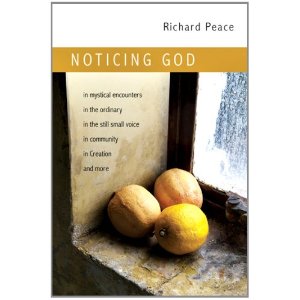
Just this morning I finished Dr. Richard Peace's new book, Noticing God. Here is my review.

The title of this book--Noticing God--suggests something astonishing to the average reader: That God is everywhere, and noticing him is a possibility.

Dr. Richard Peace takes a slippery and often miscommunicated topic--the awareness of God's presence and actions in the world--and makes it accessible, reasonable, and hopeful. While there are familiar tours through some classical spiritual disciplines and practices, Dr. Peace also recognizes that God sometimes appears to people in some very ordinary places, such as quiet voices, dreams, worship, and community.

This is no muddled journey through pantheism or foggy mysticism, but rather an embrace of the story of God's engagement with human beings through the narrative of Scripture, the accounts of saints throughout the ages, and experiences of contemporary pilgrims. Dr. Peace confesses his own cautions and concerns about claims made by some people (cautions and concerns that I share as well), and in doing so gives the reader permission to hold loosely to assertions about things God might or might not be doing in the world, and offers tools for processes of discernment within the Christian community.

One does not have to look far for books that tell stories of explosive encounters with God. Whether or not those stories are true, they can sometimes leave people with a sense of personal inadequacy, assuming that their own apparently meager (or non-existent) encounters with God cast them into second-class citizenship in God's kingdom. Dr. Peace heals that wound by considering the diverse and creative ways in which God reveals himself to people, and encourages even the most reluctant Christian mystic to open both eyes and ears to the possibilities of God's movement in both the dramatic and the ordinary.

This is a book designed for real people in real communities of faith. The exercises and questions at the back of the book offer valuable frameworks for group and individual engagement with the text, and also open the expectations of faith that anticipate a life that experiences the God of Abraham, Isaac, and Jacob--the one so supremely revealed in the person of Jesus Christ.

Friday, April 27, 2012

The Church, The State, and Care for the Poor


Rep. Paul Ryan’s recent speech at Georgetown University seems to have caused some of his Catholic brothers and sisters to take issue with Ryan’s budget proposal, viewing it as incompatible with Catholic teachings, especially in relation to care for the poor.

This brings up an interesting set of questions: Does the so-called “Separation of Church and State” doctrine prohibit such connections in the first place? Doesn’t that doctrine make the influences of any religious group unwelcome when it comes to the affairs of state? What is the church’s relationship to the state when it comes to topics like this?

First, as I understand it, the idea of separating church from the state was intended to prohibit the government from establishing a state religion. It was a clear reaction to the power of the Church of England, and the colonial framers of the US Constitution did not want to repeat what they considered to be an inappropriate alignment of power in Europe.

Second, to demand that any persons holding a place of governmental responsibility disallow their religious influences and values as they engage in the processes of policy-making is not reasonable. Whatever has formed a person—religious faith, past experiences, reason, education, and so on—will become part of the lens through which that person sees how things should work in the world. No one comes to the governmental table (or any table, for that matter) as a blank slate.

Having said this, I still have to wonder about the demands that religious groups—specifically Christians—can really make on the government. Certainly, in a culture based on individual rights, religious folks can makes all kinds of demands. But what is the place of Christian communities in the context of the nation?

That the church at large would call the state to act justly and fairly is a good thing. However, is it right that we would expect the state to act as though it is the church? Again, I’m all for the state being called to justice and fairness, but in the end isn’t it still appropriate that faithful communities of Jesus continue to enact the realities of the kingdom of God, regardless of the acts of the state?

In the CNN article about Rep. Ryan’s speech, a recent survey among American Catholics is cited that shows a decrease in concern for the poor. Could that be a result of the expectation that care for the poor is more a function of the state than it is a core expression of the church’s love for Jesus? If the state, even appropriately, enacts programs to care for the poor, does the church begin acquiesce its own identity in the world?

Tuesday, April 24, 2012

Finding a bridge between consumption and production

In his book Being Consumed: Economics and Christian Desire, William Cavanaugh writes, “Consumerism is an important subject for theology because it is a spiritual disposition, a way of looking at the world around us that is deeply formative.” And, “The problem is a much larger one: changes in the economy and society in general have detached us from material production, producers, and even the products we buy.” There’s a way to test this out: Ask a child where fruits and vegetables come from. If the child names a grocery store rather than a farm or an orchard, then there is probably a disconnection between consumption and production. Ask the same child where your church came from. In fact, ask yourself the same question. How many people know that a number of thriving churches started out as small group Bible studies or as church plants struggling with meager resources? I have an idea. Let’s give this a shot and see what happens. 1. Start buying produce from local growers rather than from big-chain grocery stores. Take your kids and grandkids along and help them see where things come from. Plant a garden and participate directly in the production process. Share the produce with your neighbors. 2. Connect with an organization that supports fair trade exchanges and buy things from places where you can actually see who made the item you are buying. Learn to see that real human beings dirty their hands making the things we enjoy. 3. Interview someone from your church who was involved in its beginnings, or at least who knows the church’s history. Help you and your loved ones to appreciate where buildings, parking lots, children’s ministries, etc. actually come from. None of these things will entirely break us from the ravages of rampant consumerism, but they might be ways to rebridge the gap between what we consume and the people and processes involved in production.

Thursday, April 19, 2012

Resolving the Evolution Question for Good


An NPR story (dated today, April 19, 2012) highlights the growing tension between evolutionary science and politics. However, to keep religion in the mix, I now share some personal family archival material that will put the matter to rest.

My great-grandfather, F. M. Lehman, was a traveling evangelist and hymn writer (he died when I was an infant, but I knew my great-grandmother well; she died at age 102, when I was 18). Among more well known songs, such as The Love of God, No Disappointment in heaven, and Old Time Religion, he also wrote major hits like King Nicotine Must Die, The Royal Telephone, and A String of Empties (I am not making this up).

One of my favorites was written in 1924, in an effort to put the emerging evolution controversy to rest. Here are the words to Up a Cocoanut Tree:

The “wise and prudent” tell me just what once I used to be—
A “germ” and then “tadpole;” then a “monkey up a tree.
But just because a cocoanut fell on their poor old head
Should be no reason I believe what disbelief has said.

A monkey never yet evolved to be a real man,
But man can be a monkey, just deny it if you can.
If on their head there fell a nut dropt from a cocoa tree,
I’m sure that that shall never make a monkey man of me.

Some ignoramus of the schools in mortorboard and gown
Declares this “monkey” business has been ably sifted down.
He guessed because a cocoanut fell on his hollow head
That evolution must be true; that Christ the Lord is dead.

Chorus:

They’re guessing! Just guessing—only guessing!
God made you and me. We’re no relation to the monkey up a cocoanut tree.


© Kansas City MO: Lillenas Publishing Company, 1952