Showing posts with label Fuller Theological Seminary. Show all posts

Sunday, September 27, 2015

American Evangelicals: Strategic Withdrawal?


I appreciated Laura Ortberg Turner’s recent article in The Atlantic (“What Happens When the ‘Moral Majority’ Becomes a Minority?”). She identifies a suggestion by some American evangelical leaders that Christians withdraw from the political scene, emulate the Benedictines by engaging for a season in the contemplative life, and then prepare to reemerge in order to change the culture.

It is interesting to me that, after thirty-five years of presence in American culture—a culture that identifies itself as 70% Christian and 25% evangelical—those who are associated with the Moral Majority would think that withdrawal and reengagement would result in changing the people of the United States. I wonder what they might think would be different once evangelical Christians returned to the political scene after a time of isolation. Would God allow the rest of the USA to suffer consequences in the meantime that might parallel the disasters that befell ancient Israel?

A time of rest and contemplation might actually be good for American evangelicals, if that time of contemplation is less of a strategic withdrawal in preparation for a new attack on culture, and more of a humble time of reflection about what it means to follow Jesus into the world that God loves. We could all probably use a time out in order to give thought to our identity.

I am also interested in the way that the term “American evangelical” often suggests a unified body of religious people. There are a number of prominent voices that do not speak for all evangelicals. There are seminaries that consider themselves to be evangelical, and yet differ with one another about certain areas of theology, ethics, and social justice. There is probably a lot less uniformity among evangelicals than many people think.

Roman Catholics are sometimes described as though they are similarly uniform. In reality, the Roman Catholic Church is made up of a number of orders that are expanded by many sub-orders. There are orders that focus on attending to the inward life (like the Benedictines), and those that attend to the active life (like the Franciscans). They would all say that they are Roman Catholics and share a common life of prayer, but that they also express their vocations in a variety of ways.

I once heard Dr. Richard Mouw, former president of Fuller Theological Seminary, wish out loud that we Protestants could see our various denominations in the way that Roman Catholics see their orders. I wish that for evangelicals. I wish that some would, indeed, withdraw from the divisive drama of American political life and seek a fresh identity as the people of God. I wish that others would see their evangelical vocation as humble service to the poor and suffering of the world. I’d like to see others give themselves over to the enrichment of the church, calling people prophetically to live their lives in the way of Jesus.

Maybe that’s already going on. If so, then it might be good for some of the more dominant evangelical voices to withdraw for awhile so that the caricatures attributed to evangelicals would wither and die and people might see our good works and give glory to our Father in heaven. Just maybe.

And maybe we could, indeed, redefine “evangelical” so that the term, rather than attributed to a particular block of American voters, would describe a people who continuously proclaim and demonstrate the present reality of the kingdom of God, a kingdom that Jesus said is now upon us. As such, we could become comfortable with that identification being expressed in ways as diverse as the orders of the Roman Catholic Church.

I wonder if that’s what Jesus meant when used the metaphors of “salt” and “light.”

Sunday, April 29, 2012

A Refreshing Invitation to the Presence of God


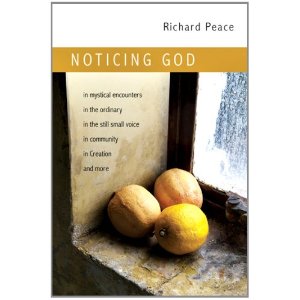
Just this morning I finished Dr. Richard Peace's new book, Noticing God. Here is my review.

The title of this book--Noticing God--suggests something astonishing to the average reader: That God is everywhere, and noticing him is a possibility.

Dr. Richard Peace takes a slippery and often miscommunicated topic--the awareness of God's presence and actions in the world--and makes it accessible, reasonable, and hopeful. While there are familiar tours through some classical spiritual disciplines and practices, Dr. Peace also recognizes that God sometimes appears to people in some very ordinary places, such as quiet voices, dreams, worship, and community.

This is no muddled journey through pantheism or foggy mysticism, but rather an embrace of the story of God's engagement with human beings through the narrative of Scripture, the accounts of saints throughout the ages, and experiences of contemporary pilgrims. Dr. Peace confesses his own cautions and concerns about claims made by some people (cautions and concerns that I share as well), and in doing so gives the reader permission to hold loosely to assertions about things God might or might not be doing in the world, and offers tools for processes of discernment within the Christian community.

One does not have to look far for books that tell stories of explosive encounters with God. Whether or not those stories are true, they can sometimes leave people with a sense of personal inadequacy, assuming that their own apparently meager (or non-existent) encounters with God cast them into second-class citizenship in God's kingdom. Dr. Peace heals that wound by considering the diverse and creative ways in which God reveals himself to people, and encourages even the most reluctant Christian mystic to open both eyes and ears to the possibilities of God's movement in both the dramatic and the ordinary.

This is a book designed for real people in real communities of faith. The exercises and questions at the back of the book offer valuable frameworks for group and individual engagement with the text, and also open the expectations of faith that anticipate a life that experiences the God of Abraham, Isaac, and Jacob--the one so supremely revealed in the person of Jesus Christ.

Friday, March 23, 2012

A Theological Perspective: UUP


I was raised up in the Wesleyan/Arminian Holiness tradition. I have to admit that I ended up appreciating that I wasn't a Calvinist, but I really didn't understand what any of it meant—even my own tradition.

Nevertheless, over the years I've leaned more toward the Wesleyan/Arminian tradition than the Calvinist tradition. I like to say, however, that when I arrived at Fuller seminary as a student, I had no Calvinist bones whatsoever. After I completed my degree, studying under some brilliant and devout Reformed scholars, I discovered that I at least had developed some Calvinist cartilage. I'm comfortable with that.

I've come to understand those apparently disparate views as valiant attempts to put in systematic language the mystery of what God has done in and through the person of Jesus Christ (you can find a helpful and simple comparative chart of the two views here). And while I tend to hold loosely to any systematized framework for theology, I've gone and created one of my own, which I currently like. Here it is, utilizing the acronym UUP (hopefully pronounced "UP" rather than "OOP," although either could be appropriate depending on one's response):

Universal love of the Father. There is plenty of scriptural precedent for God's love for the entire world.

Unlimited atonement. What God has done in and through the conception, birth, life, death, resurrection and ascension of Jesus has been done for the sake of all of humanity.

Particular response to the work of the Holy Spirit. The Spirit calls, but not all will respond. Some will even reject.

That's where I am these days. I think I'll continue getting in over my head by addressing election, heaven, and hell in my subsequent posts.

Thursday, March 1, 2012

Stumbling Toward the Cross

As we draw nearer to Holy Week, I am sharing another excerpt from my book Atonement at Ground Zero: Revisiting the Epicenter of Salvation (to released in the Spring 2012).

—

It should be no mystery that human beings are drawn to the idea of atonement. After all, it would be the rare person who would not agree that there is something wrong with the world and, by association, with all people. As Christian thinkers throughout the ages have wrestled with atonement theory, the looming realities of evil, guilt, and shame have demanded their attention. Various cultures have sought to appease their deities with sacrifices and rituals; Christians have tried to understand how it is that Jesus takes care of everything for us. In this book I have tried to explore that understanding primarily through the experiences of those present at or near the time of Jesus’ death.

None of those present at the ground zero of Jesus’ crucifixion would have divorced him from the life that led to the cross. His death was not an isolated theological event but rather an explosive, mind-numbing experience that translated quickly into joy, hope, and mission. Even those who did not know Jesus before the crucifixion—such as many among the gathered crowds and the executioners—would have seen a real, live human being dragged to the cross and nailed down like a wind-blown shutter. For all present, Jesus’ death was tied intimately to his life.

During a class session in systematic theology, my seminary professor—a man not shy about stirring up controversy—asked the question, “If, in the garden of Gethsemane, under the great stress of anticipating his impending arrest and crucifixion, Jesus died of a heart attack, would he have died for our sins?” I didn’t immediately know how to answer his question, but I expected a lively and spirited class discussion to explode any second. I was not disappointed.

My professor was not attempting to disparage the reality of the cross. Rather, he was attempting to get us to think about the implications of the incarnation. If, indeed, in Jesus the fullness of God dwelt (Col 1:19); if, indeed, Jesus is the Word made flesh (John 1:14), then God has done something in and through the entirety of Jesus’ existence on earth that defies complete and full comprehension. The cross is not God’s cosmic gamble, his hope-against-hope that Jesus doesn’t miss his opportunity for crucifixion; the cross is the penultimate event in the life of the one who became “. . . like his brothers and sisters in every respect” (Heb 2:17a), yet an event that was ultimately turned on its head by Jesus’ resurrection.

While the separating of Jesus’ crucifixion from the full story of his preceding life and subsequent resurrection is faulty theology, it would be no less faulty to treat his death as an event that was incidental because of its human inevitability. We are helped when we remember that we are not asked to come to grips with the man Jesus who is sacrificed by God for the purpose of God’s satisfaction, but rather with the Son . . . “whom [God] appointed heir of all things, through whom he also created the worlds. He is the reflection of God’s glory and the exact imprint of God’s very being” (Heb 1:2b-3a).

Atonement theory stumbles when it separates the Father from the Son and pits them against each other in a tragic and violent relationship of appeasement. When the Son becomes a perfect, sacrificial other who brings satisfaction to the transcendent God who demands such a requirement, then our understanding of the depth of relationship that is shared by the Father and Son suffers from abuse. While the relationship of the eternal Father to the suffering and dying Son raises questions about the nature of God, creating a chasm between the Father and Son that is bridged only by the Son’s death is a solution grounded more in the concept of blind western justice than in the doctrine of the Trinity.

Thursday, February 23, 2012

We Need The Table of Jesus


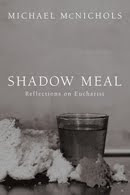
A couple of years ago I wrote a book about the Lord’s Supper, titled Shadow Meal: Reflections on Eucharist. After doing some speaking engagements on the book and trying to promote it (as authors have to do), I discovered something interesting:

It was more attractive to Catholics than to Protestants.

This is strange to me because the book is both personal and theological. It’s about my own journey as someone raised up in low church (as in non-liturgical/non-sacramental), trying to figure out why the Lord’s Supper has meaning. Richard Mouw, President of Fuller Theological Seminary, was kind enough to write the foreword, and in it he spoke of his own similar journey. It seems that I’m not alone.

Perhaps I shouldn’t have used the word Eucharist. It’s a very un-Protestant word, and maybe was off-putting to some. Even though it means Communion, or the Lord’s Supper, we Protestants don’t use the word as much as do our Catholic friends. But I’m thinking these days that we need to put it on again, and start exploring why the Lord’s Supper is still important for the church. And I don’t mean in the age-old debates about the nature of the bread and wine.

I mean the nature of the table of Jesus.

I believe that we who follow Jesus need a revitalized theology of The Table. I think it would help all of our arguments about doctrine, sexuality, gender, and all the other topics that divide and alienate us from one another. There are reasons, I believe, that a new theology of The Table might help us:

We don’t get to say who comes to dine. The invitation comes from Jesus, and he characteristically invites scandalous people to join him.

At The Table, all are side by side, shoulder to shoulder, allowing their humanness to physically engage. That’s why we ought to share the elements of Eucharist in a setting where we stand or kneel together.

When we consume bread and wine, we share together the most common activity of people: Eating. All must eat to live, and the need for nourishment transcends socio-economic status, ethnicity, gender, and politics.

And at The Table, we shed all of our pretenses and illusions of superiority because we are suddenly laid bare: We all need Jesus, and it is only Jesus who sustains us.

After that, we can re-engage in all of our debates. But I believe they will be different, once having dined at Jesus’ table, responding to his summons to come together to share his body and blood.

We need a new theology of The Table.