Showing posts with label Christianity. Show all posts

Monday, March 10, 2014

Lenten Reflections, Day 3: Giving Up Independence


I finished up my teaching assignment on Saturday afternoon and hurried to the airport to catch my 4:40 flight home, only to find, upon my arrival, that the flight had been cancelled.

The next flight was at 6:35, so I had to hang around the airport and kill some time. It was a minor inconvenience for me—I was just heading home rather than racing for a connecting flight or trying to get to an important meeting on time. I had plenty of reading material and a computer to keep me occupied during my wait.

The man at the airline’s check-in counter was apologetic and kind. We explored a couple of options for me and agreed that waiting the extra couple of hours was the best choice. He gave me my new boarding pass and I went upstairs, passed successfully through security, and settled in.

That airline official, at the end of his shift, would climb into his car, drive home, eat dinner, chat with his family, catch up on past episodes of Breaking Bad, and go to bed. All the people who had to be redirected because of the cancelled flight, however, had evenings that were disrupted because of the delay. Each traveller—including me—had become dependent upon a man (and the airline he represented) who did not have to share the inconveniences that had been inflicted upon us. Perhaps he had to put up with some grouchy customers, but he still got to go home on time.

Given the circumstances, I am not holding a grudge against that man. He recognized my plight, helped me consider some options, and expressed his apologies on behalf of his employer. I didn’t come away feeling exploited or disparaged, even though I recognized my dependence on him and the airline to get me home at a reasonable time.

There have been times when people have been dependent upon me. How have I treated them? Did they come away with a sense that they were lesser humans than others because of their need for care? Did they feel that I had little or no concern for their pain or discomfort because it was not truly shared between us? Or did they experience me entering into their circumstance with them, helping to shoulder a burden they could not endure alone? Did they hear me express grief over a tragedy that was not mine to share, or did they just hear the clicking of my tongue as I stood away from them, glad that the sufferer was not me?

In speaking of Jesus, the writer of the book of Hebrews says,

“For we do not have a high priest who is unable to sympathize with our weaknesses, but we have one who in every respect has been tested as we are, yet without sin. Let us therefore approach the throne of grace with boldness, so that we may receive mercy and find grace to help in time of need.” (Hebrews 4:15-16)

We can confidently expect God’s mercy and grace in our time of need because we believe that, in Jesus, God has fully entered into all that it means to be human. When others become dependent upon us, may we cast our lots with the One who truly sympathizes with our weaknesses.

Thursday, January 9, 2014

The Power of the Imaginative Story: Matthew (part 6)


Jesus shakes up his listeners by declaring that certain conventional and legal actions (or inactions) are not at the heart of goodness, not at the core of righteousness. He reminds them of what everyone already knows (“You have heard . . .”) and then pulls the rug out from underneath their feet by pushing them away from their perceived moral and ethical safety zones (“But I say to you . . .”). So:

Not committing murder doesn’t eradicate the internal anger that resides in one’s heart.

Not committing adultery doesn’t magically erase the objectifying of someone as a mere object of sexual desire.

Following the legal rules that allow a man to divorce his wife—thereby forcing her into a new marriage relationship in order to avoid becoming destitute—doesn’t wipe the slate of oppression clean.

These first three admonitions, while clearly not ignoring the fact that actions and thoughts do not necessarily have the same consequences (actually killing someone brings a more severe result than just thinking about murder), bring to the forefront two important emphases:

First, there resides in the human heart the potential for the worst of human actions. Therefore, all people stand together in a sea of dark possibilities. It’s one thing to make a right judgment about something, as in bearing witness to some observable event (such as, “Officer, that car made a left turn and crashed into the light pole;” or, “I saw that man strike that woman and run away with her purse”). It’s another thing to claim that the possibilities for wrongdoing and error do not exist in those of us who haven’t committed any crimes. Such a claim is at the heart of judgmentalism.

So, just because a person didn’t pull the trigger on the gun doesn’t mean that her inner anger, an anger that makes murder a possibility, has no unrighteous power.

Just because a man hasn’t cheated on his wife doesn’t mean that his constant lusting over his neighbor’s wife doesn’t have the potential to destroy lives and relationships.

Second, legal permissions and boundaries do not necessarily mirror what is truly right. In Jesus’ day, a man could divorce his wife, sometimes on flimsy grounds, as long as he gave her a certificate of divorce (most likely a legally-recognized document that freed her to marry another). To be a divorced and disempowered woman in that time would be a sure ticket to destitution. Jesus wouldn’t allow for such a legally protected action, as though the boundaries of the law eliminated the destruction that would surely follow.

I wonder how things would change for us if, when we heard that someone did something awful, rather than saying, “How could he do that?” we lamented, “I am capable of the same thing.”

I wonder how generous our hearts might become if, while respecting the reality of our national laws, we didn’t allow legal regulations to be the ultimate definers of righteousness? For example:

Do the existence of immigration laws and national borders mean that “neighbor” is defined only by the legalities of residency and citizenship?

When the courts make a declaration requiring obedience—whether related to abortion, marriage, immigration, discrimination, and any number of other important issues—is the conversation over for followers of Jesus? Or do we look to him and wait for him to say, “But I say to you . . .”?

The words of this sermon in the gospel of Matthew—typically called “The Sermon on the Mount”—have been studied, reflected upon, and cherished by people for centuries. But they are not necessarily words of comfort. They force us as readers to confront ourselves and challenge our own perceived securities.

There is a road leading down from a mountain in Mexico where I have ridden my bicycle several times. There is a big sign on the side as the road begins its winding, eight-mile descent. The sign reads, “Curvos Peligrosos.” Dangerous Curves.

There should be a heading at the beginning of this message from Jesus that reads: “Palabras Peligrosas.” Dangerous Words.

Wednesday, January 8, 2014

The Power of the Imaginative Story: Matthew (part 5)


In the movie Minority Report, the minds of three young seers are tapped to give future law enforcement authorities the ability to stop crimes before they actually happen. These glimpses into the future allow the police to thwart wrongdoing—especially murder—when the acts are nothing more than possibilities bubbling in the perpetrators’ minds.

Jesus said some startling things about guilt, sin, and righteousness—things that didn’t allow for the disconnecting of the mind from the body, of intentions from actions, of the state of the heart from the committing of the crime. He showed that the apparent outward righteousness of certain religious leaders—specifically the Jewish scribes and Pharisees—was a smokescreen that obscured the hidden realities of their inward realities. He wasn’t shy in his attacks against their hypocrisies and would say things like,

“Woe to you, scribes and Pharisees, hypocrites! For you are like whitewashed tombs, which on the outside look beautiful, but inside they are full of the bones of the dead and of all kinds of filth.” (Matthew 23:27)

As Jesus sat with his followers on the side of the mountain, he must have shocked them with the contrasts he made concerning what they had learned from their childhoods in home and synagogue against the deeper way of thinking about life that he was laying before them. He challenged them with seven brain-twisting examples drawn from the law of Moses and also from conventional folk wisdom:

Murder

Adultery

Divorce

Oaths

Retaliation

Love for the enemy

Giving of alms

Jesus brilliantly reminds his followers about what they have heard about each of these topics, and then moves behind the veil and reveals the heart that birthed each action. Are people free from the sin because they haven’t committed murder or adultery? No, because the reality of anger and lust in the human heart binds all people together under a shroud of guilt where the seeds of destruction and violation are planted, sometimes sprouting and sometimes not.

Are people safe when they build walls against one another through the legalities of divorce, the craftiness of contractual language, rules allowing for revenge, and the acceptability of hatred? Jesus collapses them all, and draws his listeners into ways of engaging with others in the completeness of love that comes only from God.

It was probably easy for people in Jesus’ day to allow social, religious, political, and military frameworks to provide artificial safety zones in which to live. It’s just as easy for us to do it as well. It’s easier to label other people as sinners when we deny the realities of our own hearts. It’s easier to allow the boundaries and borders of nation-states to define the word “neighbor” than it is to see all people as co-humans made in the image of God. It’s easier to crush others under religious dogma than it is to listen deeply and find where God is already at work in the lives of those who are not like us.

There are many areas of life and thinking where Jesus rightly declares, “You have heard that it was said . . . .”

It’s more important for us to hear, “But I say to you . . . .”

[See Matthew chapter 5 for the details of Jesus’ words to his followers]

Tuesday, January 7, 2014

The Power of the Imaginative Story: Matthew (part 4)


The ancient laws chronicled in the Old Testament often confound people. It’s not just the Ten Commandments, but also the myriad of dietary/social/economic laws that fill the pages of books like Leviticus and Deuteronomy (not most people’s preferences for devotional reading). The laws seem to us to be mostly irrelevant in our time and provide us with clear evidence of the fruitlessness of legalism when it comes to pleasing God.

Or, could it be that something else is going on here?

Imagine the ancient Hebrew people as they suffered through generations of slavery under the yoke of the Pharaoh in Egypt. After their rescue under Moses’s leadership, they wandered in the wilderness for a long time before landing in a place that would become their homeland. What was going on for them in that long sojourn?

They were being reformed.

The lens through which the people saw the world would be colored by their experiences of captivity in Egypt. Their religious views would be as permeated by Egyptian mythology as much as it was by early Semitic worship practices. How would they move from a people oriented around slavery to a people with a destiny crafted and energized by the God of the universe?

They would be reformed by adherence to laws that would reorient every aspect of their lives. They would be required to think in new ways about human relationships and interactions, the nature of life-giving work, the purpose and effects of communal worship, and care for the world around them. It would take a great deal of reorientation to extract the mentality of slavery from the people and to reorient them around the presence of the God who had rescued them from Egypt.

And Jesus sits on the side of the mountain and tells his disciples, “Do not think that I have come to abolish the law or the prophets; I have come not to abolish but to fulfill.”

It appears that, for Jesus, the law and the prophets were not static propositions but rather signs and wonders that continuously directed the people into the living presence of God. Yet the law had become rigid and life-draining in Jesus’ day, framed by the religious elite as measurements of personal righteousness, a righteousness attained by disciplined adherence to the ancient code of Moses.

And Jesus must have startled his followers when, after affirming the authority and purposefulness of the law and the prophets, he warns of a distortion that was evidenced in the Jewish religious leadership of the day:

“For I tell you, unless your righteousness exceeds that of the scribes and Pharisees, you will never enter the kingdom of heaven.”

And what comes next will shake people’s understanding of righteousness for centuries to come.

Monday, January 6, 2014

The Power of the Imaginative Story: Matthew (part 3)


As Jesus looked upon the crowds from his vantage point on the side of the mountain, he called them blessed. His disciples, gathered around him as he spoke, must have recognized that Jesus’ words were not spiritual abstractions, but statements of reality. The crowds had come to Jesus, and “they brought to him all the sick, those who were afflicted with various diseases and pains, demoniacs, epileptics, and paralytics, and he cured them.” The blessing to which Jesus referred had been experienced in the lives of the people, not simply anticipated as a reward for spiritual purity.

The tone of Jesus’ message shifts as his attention moves from the crowds to his disciples. He now speaks of blessing that comes to “you”—those now gathered before him:

“Blessed are you when people revile you and persecute you and utter all kinds of evil against you falsely on my account. Rejoice and be glad, for your reward is great in heaven, for in the same way they persecuted the prophets who were before you.
“You are the salt of the earth; but if salt has lost its taste, how can its saltiness be restored? It is no longer good for anything, but is thrown out and trampled under foot.
“You are the light of the world. A city built on a hill cannot be hid. No one after lighting a lamp puts it under the bushel basket, but on the lampstand, and it gives light to all in the house. In the same way, let your light shine before others, so that they may see your good works and give glory to your Father in heaven.”

These are words about vocation, the vocation of following Jesus, of learning anew what it means to be the people of God. There will be persecution—the history of Israel’s prophets confirms the inevitability of resistance. But there will also be the embodiment of God’s intentions for the rescue of the world, an intention first spoken to the ancient patriarch Abram as he was summoned from his nomadic life into a destiny that would result in the nation of Israel:

“I will make of you a great nation, and I will bless you, and make your name great, so that you will be a blessing. I will bless those who bless you, and the one who curses you I will curse; and in you all the families of the earth shall be blessed.” (Genesis 12:2-3)

The blessing that Jesus extended to the crowds brought healing and life. The blessing that he gave to his followers drew them into God’s mission. Once again, this blessing was no abstraction; the blessing came as the result of responding to the call of Jesus to follow him. Those who put their trust in Jesus would not create a new religion—they would renew and enliven God’s original intention for Israel for the sake of the entire world.

Friday, January 3, 2014

The Power of the Imaginative Story: Matthew (part 2)


Jesus sits on the incline of the mountain and positions himself so that he can look into the faces of his disciples who are gathered before him, but also to look beyond them to the crowds gathered in the valley below.

What is he seeing?

He sees many who are poor, not only in terms of resource but also in terms of life. Their very bodies suffer the poverty of malnutrition and disease, and the hope of a renewal of God’s breath within them is vague at best. That is, until Jesus has touched them. He sees them in the distance and brings them out of the depths of despair when he claims,

“Blessed are the poor in spirit, for theirs is the kingdom of heaven.”

There are those who have given up on their lives, seeing their suffering and pain as evidence of God’s disinterest in them. Others came in despair, having lost hope that their loved ones might be made whole again. But Jesus declares a reality that they are only beginning to experience, and he calls out,

“Blessed are those who mourn, for they will be comforted.”

Many who have brought loved ones to be healed by Jesus have spent long periods of time as caregivers. Some might have taken on their tasks grudgingly, but others would bring care with love and gentleness, characteristics that would not have put them in league with the strong and powerful of the world, those who would not be encumbered by the concerns of the infirm. Jesus sees those who exhibit humility and points them toward a surprising destiny:

“Blessed are the meek, for they will inherit the earth.”

There would be those in the crowds who strained against injustice—injustice seen in the dominance of the Romans over the Jews, injustice within the very life of Israel, and the injustice of sickness and pain being visited upon God’s people. They would long for things to be put right in the world and for God’s intentions to be made real in the here and now. They long also for their own hearts to be made right before God. Jesus celebrates their longing and gives them hope:

“Blessed are those who hunger and thirst for righteousness, for they will be filled.”

There would have been many people in the crowds who had left homes and businesses to bring others to the feet of Jesus. Many of those who were suffering would have been incapable of such travel on their own. They would have been dependent upon the mercy of others whose bodies were whole and strong to carry them to the valley were Jesus might bring his healing. Those who had given of themselves for the sake of others did not miss Jesus’ notice:

“Blessed are the merciful, for they will receive mercy.”

One of the insults branded upon Jesus by his opponents was “friend of sinners.” Jesus was not put off by those who lives were lived out on the fringes of religious and social respectability. In his encounters with these “sinners,” he found some who, in the midst of their brokenness, exhibited a transparent innocence, an innocence that allowed them to be exposed before Jesus so that he might draw them into a new kind of life. Unencumbered by the scheming and posturing that often characterized the strong and powerful, their eyes were opened to the fullness of God that was in Jesus. Jesus saw them, too:

“Blessed are the pure in heart, for they will see God.”

It may be, because of the large gathering of people, that soldiers were present on that day. They might have been Jewish temple guards or even Roman soldiers, standing off and away from the crowds, watching in case some form of insurrection might be brewing. Jesus sees them just as he sees the others, and he redefines their vocations, calling them away from the corruption and violence that was always a possibility for them, and to a new view of themselves of ones who might foster peace in a violent and destructive world:

“Blessed are the peacemakers, for they will be called children of God.”

Stories of Roman persecution of the Jews were commonplace in Israel. Some were devastated financially by unfair taxation. Others might have suffered at the hands of Rome’s interrogators whenever plots to overthrow Roman rule were suspected. Many had been sent to their deaths, rows of crucified bodies reminding the populace of the power of the dominant rulers. Perhaps even anticipating his own suffering and death, Jesus refuses to allow those who have been sinned against to be forgotten:

“Blessed are those who are persecuted for righteousness’ sake, for theirs is the kingdom of heaven.”

Jesus sees them all, and calls them blessed. He draws them—the sick, the tormented, the poor, the unpowerful, the marginalized, the “sinners”—away from the fringes of life and into the circle of God’s love. It is a place of God’s blessing, a place were hope and healing thrive.

It is a much larger circle than anyone could have imagined.

Monday, July 1, 2013

Making Friends with an Atheist


My daughter brought the above flyer home from the local university where she was studying a number of years ago. She didn’t take it to discourage people from attending the meeting of the Atheists and Agnostics Club (after all, the flyers were everywhere); she took it because she knew I’d be interested. And she was right.

I actually thought the use of the fish image was pretty clever. So, I accessed the contact information at the bottom of the page (blacked out for the sake of anonymity) and emailed the contact person. I said that I was a pastor, explained how I had obtained the flyer, and asked if he would he be willing to have lunch with so that I could hear about his club? It turned out that he was the president and founder of the club, and he agreed to meet.

He was a commuter student and lived 35 or 40 miles away from the campus, so we met at a coffee shop somewhere in between. He was bright and assertive, and I liked him right away. I learned that he had been raised in a very conservative Christian household and was the only member of his family to discard Christianity and embrace atheism. His family and other people had, apparently, challenged him many times about his views of faith, and he figured I would continue that process. He started asking multiple questions, all of which seemed designed to get an argument going.

I’m afraid I disappointed him, at least at first. I said I really didn’t care about debating some of the things that others might desire. I just wanted to know why his atheism was important to him and why he felt he needed a club. Mostly, I just wanted to know about him.

Gradually, our conversation shifted. I asked about his life, what he was studying, what he wanted to do in terms of work, and so on. He had a number of high aspirations in terms of education and, like many college students, was still trying to work out what he would pursue in terms of a career.

The university where he and my daughter were studying had about 30,000 students at the time. I figured that my young friend’s club had a respectable number of members. Imagine my surprise when he told me that there were only eight people who had joined. And they were all his friends.

I couldn’t help but laugh. But it wasn’t a laugh of mockery or disdain. You see, I was a pastor of a church that I had planted, and I constantly wondered where all the people were. So I said to my new friend:

“I’m sorry. I’m not laughing at you. I’m just feeling your pain. I know that it’s really hard work to draw a crowd when the topic is ultimate reality.” We both laughed at that.

After a while, he became quiet, and I could tell he was thinking about something. He said,

“It just occurred to me that you have nothing to gain by talking to me.”

I agreed. I told him that I didn’t come to get him to do anything, or to convince him to come to my church. I just wanted to hear his story and find out about the heart behind the conviction. He said he might surprise me someday and come to a service. I think he actually showed up once.

He did, however, call me a year or so later and asked to have lunch again. This time we met not far from the university, at a favorite pub of mine. He was excited about his next step in life, moving to a respected and prestigious university campus where he would pursue his PhD. I told him I was glad for him.

Then he smiled at me and said, “I have to tell you something: I’m not an atheist anymore.”

This, of course, caught me attention. “What happened?” I asked.

“I’ve decided that I’m really more of an agnostic.” I wondered if our prior conversation had anything to do with that shift in his beliefs.

His face darkened as he spoke. “But,” he said, “when I told my friends in the club about the change in my thinking, they became angry. They voted me out.”

I was sad for him. His friends excommunicated him from fellowship because of an honest shift in his belief system. I was sorry that he had to carry the cloud of abandonment and rejection into this new season of life. But I was glad that he chose to come and tell me about it.

I’ve thought about those conversations a lot over the years. It bothers me that our culture—and I mean the culture as a whole—is short on listening and long on anger. I worry that we are becoming a people that uses terms like love and hate to categorize those who agree with us against those who do not. I am troubled when we see human beings as mere symbols of ideology rather than as real people with stories to tell and hearts that long for meaning and acceptance.

We who claim to follow Jesus ought to be good at listening and caring, but I’m not sure that we’re any better at those things than anyone else. There is something in the Bible about this:

You must understand this, my beloved: let everyone be quick to listen, slow to speak, slow to anger; for your anger does not produce God’s righteousness. (James 1:19-20)

Let it be so among us.

Wednesday, May 29, 2013

How do we believe in Jesus?


In the gospel of John, chapter 7, the issue of belief in Jesus appears three times. The first is in reference to Jesus’ brothers, who think he needs to do some serious self-promotion:

So his brothers said to him, “Leave here and go to Judea so that your disciples also may see the works you are doing; for no one who wants to be widely known acts in secret. If you do these things, show yourself to the world.” (For not even his brothers believed in him.) (7:3-5)

The second refers to the crowds who concluded that Jesus must be the Messiah, regardless of the religious leaders’ antagonism toward him:

Yet many in the crowd believed in him and were saying, “When the Messiah comes, will he do more signs than this man has done?” (7:31)

The last comment about belief comes directly from Jesus, who stands up and makes an impassioned plea to the crowds on the final day of the festival:

“Let anyone who is thirsty come to me, and let the one who believes in me drink.” (7:37b-38)

When we speak of belief in Jesus today, we are usually talking about belief in the historicity of Jesus, his virgin birth, the atonement, the resurrection, and so on. We can wrap our beliefs in various creeds and theologies, and pledge allegiance to them and say that we are Christians.

But what was it that the people in John 7 were expected to believe in? It doesn’t appear that the virgin birth was a point of discussion, and there was not yet a death, resurrection, or ascension to believe in. There were no New Testament texts of Scripture to claim as authoritative and the creeds were yet to be written. They weren’t asked to believe in Jesus as though he was Casper the Friendly Ghost, because he was right there in the flesh. So, what did belief look like for those people?

Somewhere in his writings I seem to remember N. T. Wright talking about what it might have meant in the first century CE to believe in someone. He cites a document written by Josephus who asks that people believe in him—that is, to believe that what he was saying was true and must be heeded.

That makes sense for the people of John 7, since Jesus was standing right there among them, speaking and acting. But I wonder if his call for people to believe in him goes even a bit further than just embracing the veracity of his words.

In the New Testament, the Greek word that is typically translated as belief is pistis, a word that is a sort of noun-verb mixture and able to convey a whole assortment of ideas, including faith, loyalty, fidelity, and—very importantly, I think—trust. With our western brains we seem to be most comfortable with the translation belief because we like to keep ideas and concepts confined to our brains where they belong. But those early witnesses to Jesus would not suffer such limitations. For them to believe in Jesus was not to have a grasp of an orthodox Christian belief system. It was to trust in a real person, to trust that his words were true, that his miraculous works came from the hand of God and were signs of God’s kingdom that was on its way.

This is, I think, an important distinction. Belief has the ability to remain abstract and propositional. Trust, however, is relational. Trust comes from a shared experience of reliability and faithfulness. For those ancient people to believe in Jesus was to trust in him as a person, someone real they could touch and experience just as real people do. They would have to trust in him before there would be the benefit (or, in some cases, the distraction) of theological interpretation and creedal affirmations.

There are some folks wandering around who still think that believing in Jesus is to trust him as one who is still present and at work in the world. Sure, we get fuzzy at times about how in the world this whole idea of the Trinity works out—whether it is the Father, the Spirit, or the Son at work—but these people care less about that kind of theological clarity and more about the real presence of the real Jesus.

I think we all have something to learn from those folks. I’ve been with people who will fight to the death over a point of theology, and even break relationship over such disagreements (it’s a core Protestant value, it seems. Luther and Zwingli parted company over the nature of the Eucharist even though they agreed on most everything else). But what would we do if we were standing near Jesus when he healed the sick, or raised the dead, or cast out a mob of demons? If he then turned to us and claimed that the kingdom of God was at hand, would we trust that he was being truthful with us?

Would we trust him?

Friday, May 10, 2013

Remembering Dallas Willard


Some years ago my friend, Todd Hunter, invited my wife and me to join him and a few other pastors for lunch with Dallas Willard. It was during a conference in Phoenix that Todd and Dallas were leading, and I was excited to meet Dallas and spend a little time talking with him.

The conversation around the lunch table touched on a number of interesting topics. I asked Dallas if he thought that the concept of formal church membership was dying in the US. He said, “If we don’t give people a way to belong, then we leave them to the ravages of consumerism.” How does someone come up with a statement so memorable over a club sandwich and iced tea?

After a while, a young church planter at the table told a remarkable story. He was working with a team to plant a church in Beirut, Lebanon. They had two kinds of gatherings: One for Muslim inquirers who wanted to engage in conversations about faith, and one exclusively for their small group of Christians, where they could talk, pray, and worship freely.

One of the members of his team had become acquainted with a Muslim woman who was a high-profile Lebanese journalist. She expressed interest in hearing more about Jesus, so he invited her to a gathering.

But it was the wrong gathering.

When she arrived on the appointed evening—an evening reserved for prayer and worship—the young pastor was understandably nervous. What would be the consequences of this well-educated Muslim woman experiencing Christian, charismatic worship? It was too late to make any changes in the agenda, so a CD of worship music was popped into the player (no one apparently had a guitar), and the time of worship began.

He said that, initially, the woman just watched the others as they stood, kneeled, lifted hands in the air, and worshipped Jesus with abandon. He closed his eyes and prayed that the Lord would protect them from trouble. When he opened his eyes a song or two later, he saw the woman standing on her feet, hands raised in the air, and tears streaming down her face.

Most of us thought this was a great conversion story. But then the young pastor asked a question that revealed his purpose in telling the story in the first place. He said,

“The thing is, Dallas, that this woman now considers herself to be a Muslim who follows Jesus.”

Before anyone else could respond, Dallas firmly declared,

“How could she be anything other than that?”

After my head quit spinning, I was able to give deeper consideration to his statement. He wasn’t, as some might assume, allowing the woman to conflate Christianity and Islam, creating her own private mix of religions. Nor was he diminishing the lordship of Jesus. He was opening our minds to something that I’ve come to understand a little better over the years: That religion is, for many people, as deeply imbedded in culture as it is in a formal belief system.

For the woman in that story, to stop being Muslim might have been the equivalent of turning in her Lebanese citizenship. It is very likely that her relationship to Islam was tied as deeply to her relationships with family, friends, and culture as it was to her system of belief.

When you stop and think about it, we in the Christian world have our own versions of cultural embeddedness. Perhaps we can understand how our faith becomes much more to us than adherence to a creed. We have traditions, practices, memories, language, and relationships that are deeply entwined in our belief systems.

I continue to be grateful to Dallas for his gift of time on that day. I’ve shared this story many times over the years, especially with my seminary students, and most have found it helpful.

Sometimes I’ve wondered about the intellectual and spiritual loss that occurs when someone like Dallas Willard leaves us. Where does it all go? I’ve decided that it goes into those of us who remain, and our responsibility is to be, to even the smallest degree, that same kind of person for the benefit of others.

Thursday, May 9, 2013

The Self-Thwarting God


Sometimes we speak of God as though he is strangely self-thwarting. We talk and sing about how we deserve God’s wrath, how we ought to die because of our sins, and how God rages against our transgressions. We speak about God loving the sinner but hating the sin, which doesn’t make good theological sense in the first place. If God is only mad about sin, then his wrath is only directed at something that is separate from us. But that’s not how we speak. We speak of God’s anger being directly and specifically toward us.

God is strange, indeed. It seems that he is self-thwarting—he stops himself from doing what he is inclined to do, which is to wipe us out. He sends Jesus to us because someone has got to die or God is going to lose control. Fortunately, Jesus pulls it off and God doesn’t kill everyone. He’s still mad, of course, but Jesus runs interference for us and keeps God at bay.

Sometimes we speak that way. We need better ways to speak of God.

Dallas Willard, who passed away yesterday, had some helpful words in this regard (thanks to Rachel Held Evans for posting this quotation from The Divine Conspiracy):

“We must understand that God does not 'love' us without liking us - through gritted teeth - as 'Christian' love is sometimes thought to do. Rather, out of the eternal freshness of his perpetually self-renewed being, the heavenly Father cherishes the earth and each human being upon it. The fondness, the endearment, the unstintingly affectionate regard of God toward all his creatures is the natural outflow of what he is to the core - which we vainly try to capture with our tired but indispensable old word 'love'.”

There are a number of instances in the Bible where God’s wrath is the equivalent of allowing people to suffer the consequences of their actions. For example:

Adam and Eve crash, and the consequences are dire and irreversible. But God meets them in their hiddenness and shame, fashioning new garments for them.

The people of Israel want a king other than God, and God lets them have what they want. As a result, the nation fractures and then collapses, and the people are exiled. But God still brings them home again.

Young Saul (soon to be Paul) persecutes Christians, becoming guilty, in effect, of persecuting Jesus. But Jesus comes to him and conscripts him into friendship, launching him into his famous missional/theological life. But Paul would always carry the memory of his past offenses.

We should not speak of a bi-polar God who is shifts eternally between rage and love. The Bible does not teach us that the core of God’s being is anger. God’s essence is love. That does not mean that God does not react negatively toward the power and effects of sin. But we dare not caricature him so that he looks to us like a petty despot who needs suffering and death in order to be appeased.

Friday, April 26, 2013

The Undead and Christian Theology


Not too long ago a friend contacted me and suggested that I submit a paper to be read at Azusa Pacific University’s upcoming Conference on Christianity and Literature, titled The Company of Others: Literary Collaboration and the Common Good. My friend knows that I write both non-fiction and fiction, and she was interested in having me produce a paper that deals with dark, supernatural stories and what place those stories have in literature that might be described as Christian.

So, because I don’t know how to say no to opportunities that are completely outside of my levels of competence, I agreed. The steering committee, for some bizarre reason, accepted my abstract. I share it with you now:

“Christians have long accepted the graphic accounts in scripture that describe horrific violence and bloodshed as part of the narrative of God’s work and mission in the world. Those stories carry into the text the tragic and gritty reality of evil, even when such evil is perpetrated by seemingly good people. The horror genre, as with others, contains the possibility of contrasting the good news of Jesus Christ with the dominant claims of evil and injustice. This paper argues that contemporary Christian horror literature personifies evil in characters ranging from the monstrous (e.g. vampires, zombies, werewolves) to the monstrously human (e.g. serial killers and other rogues), while at the same time embedding important theological themes. Without forcing a story into an allegory or an agenda, Christian writers can allow such themes to play out in a macabre tale without giving way to either gratuitous violence or unrealistic sanitization. Literature to be discussed includes Bram Stoker’s Dracula, C. S. Lewis’s Perelandra and That Hideous Strength, and Frank Peretti’s The Oath.”

Having written the abstract and realizing that it had been accepted and I was now on the program, I figured I’d better actually write the paper. It’s almost done now, but it has been a challenge to write something that is somewhat outside of my scope of qualification.

But I don’t read my work until the end of the conference, so it will be too late to kick me out if my paper is scandalous and I embarrass myself, which I’ve done before and it’s not really all that bad of an experience once you hit a certain age and merely find yourself and others amusing.

I’m grateful to my friend for extending the opportunity and I’m looking forward to hanging around with some big-brained literature people. I expect to learn a lot at the conference. I noticed that another person on my panel is reading his paper about the theology in zombie movies. He is from the same institution where I am employed. There might be a theme here . . .

Thursday, April 25, 2013

Worship Revisited


My friend Jason Clark presented a brilliant paper at the Society of Vineyard Scholars conference last week in Anaheim. He shared it with me and I’ve been thinking about it for the last couple of days. The title of the paper is:

Worship as re-narration: The unique problems and possibilities of Charismatic Evangelical Worship in late capitalist society.

Jason is British, which means that it took me a long time to read the paper because there were very long words that replaced the American Z with a British S, causing me to stop and stare, making vain attempts at re-interpretation, and then falling asleep and waking hours later, wondering where I was. But I finally got through it.

Recognizing that Evangelicalism (including the charismatic brand) has fallen on hard times, he takes a look at the deep structure of it and suggests that we might be throwing out babies with bathwater if we jettison evangelical worship because it sometimes appears shallow and consumeristic, and assume that authenticity can only be found in alternative ecclesiastical settings (or lack of setting altogether).

I’ve frequently lamented the trend to link the word evangelical with various American voting blocks or with bands of anti-everything lunatics. I also think that to reduce evangelical to a hard-edged proselytizing movement or as cousins to fundamentalism are insufficient characterizations (although sometimes deserved).

We get the word evangelical from a biblical Greek word that means good news. It comes from ancient military language that describes the message and messenger that brings the announcement that a battle has been won. But in relation to God, good news is about God’s rule and reign. So, Isaiah can say,

How beautiful upon the mountains
 are the feet of the messenger who announces peace,
who brings good news, who announces salvation, who says to Zion, “Your God reigns.” (52:7)

And Jesus can say, citing Isaiah 61,

“The Spirit of the Lord is upon me,
because he has anointed me
to bring good news to the poor.” (Luke 4:18)

The word evangelical, when linked to the biblical concept of good news, moves away from claims to cultural, political, and religious power or pragmatic instrumentalism and moves toward authentic worship of God and witnesses to the present reality of his kingdom.

When the word charismatic is added into the mix, there is an expectation that this is not about mere information or function—it is about the ongoing work, presence, and power of the Holy Spirit—the Spirit of God, the Spirit of Christ (see Romans 8:9-11).

The problem with worship in the evangelical/charismatic context is that it has often been limited to music or to particular ecstatic phenomena. But in other contexts it has been limited to the Eucharist, the sermon, or detachment from organized religion altogether.

I think what my friend Jason (which, in America, would be spelled Jazon), is communicating is not that evangelical/charismatic brands of worship have it all together, but rather that there is imbedded in the essence of that shared ecclesial life and theology the potential for reframing the holistic, expansive, and truly spiritual nature of worship.

I would love to see worship expressed in corporate gatherings in music and song, reflection on the scriptures, prayers of the people, ministry of the Spirit, prophetic utterances, confession and thanksgiving, fellowship and friendship, generosity and care, Eucharist, blessing, and sending.

The only problem with my idea is that church services would last four or five hours each week. I’m not sure our cultural embeddedness would allow for that, not to mention the tragedy of missing lunch. Although, if the Lord’s table became a table of a true, shared meal, where all would come at the invitation of Jesus, then everything would work out just fine.

I’ll get back to you on that one.

Wednesday, April 24, 2013

The Danger of Caricatures and Cartoons


I recently saw this bold statement posted on Facebook:

“The only time religious men put their faith in science is to kill men who believe in different gods.”

I don’t know the source of the quote, but I am stunned by the caricature that it creates, one of religious zealots with bloody hands cheering as others die (the background was of a nuclear blast and resulting mushroom cloud). It assumes a great deal—that all religious men (is it only men, or are religious woman included?) desire to kill people who believe in alternative religions and that they care nothing for science until its time for killing.

I’ve seen this type of thing in a number of places, and so have you—every election season assaults us with the dark art of caricature. We religious folks are just as guilty, too often vilifying our opponents by reducing them to something ridiculous. We do that to atheists, people of other faiths (but hopefully not with intent to kill), evolutionists, and to each other when we disagree on some theological topic.

A caricature, of course, is different from a cartoon. Cartoons aren’t typically depicting particular people, but rather using animation to give life to people and animals that are fun and able to do what we regular creatures cannot do. By contrast, a caricature is a comic representation of a real person (think of those talented artists who love creating caricatures of each new US President).

Of course, a caricature is not the real thing. When we create an ideological caricature of someone, we have not depicted the person with complete honesty. But it feels victorious to mold and shape our comic representations of our enemies and then skewer them, claiming that we have won all arguments. It just isn’t honest.

Various high-profile comedians do this regarding Christianity (think of Bill Maher and Ricky Gervais*). I respect how their journeys of life have resulted in antagonism toward religion in general and Christianity in particular, but when you hear their arguments against religious belief, they come off as disbelief in things cartoonish.

But Christians do this as well. We’re not as good at listening as we ought to be. Conservatives and liberals attack the caricatures of their own creation, but rarely come to the table to listen and understand each other. Some of this comes from ignorance, but a great deal of it, I believe, is grounded in fear—fear of losing something that is important, or even fear of losing dominance and power.

I don’t believe we need to live in the kind of fear that reduces our detractors to nonsensical representations of their true selves. We who follow Jesus don’t have to live in the kind of fear that claims we have things to lose, because we don’t own anything in the first place. It is we who are in the grip of God, and if anyone owns anything it is him. We should be free to engage honestly with those who stand in opposition to us, refusing to take the bait of false characterization.

The apostle Paul, I think, had something to say about this:

“So then, putting away falsehood, let all of us speak the truth to our neighbors, for we are members of one another.” (Ephesians 4:25)


*But I must confess that Ricky Gervais is one of my favorite comedians. Sorry.

Wednesday, April 10, 2013

Defining Heresy


Recently I heard about a man calling another man a heretic. They were friends at one time and had been part of the same Christian community. But one of them moved on to another group of Christ followers and, because of his new affiliation, he was labeled heretic.

I was invited to speak at a small gathering of scholars where the first man was present. Before I arrived, he inquired about my grip on orthodoxy: Was I a heretic? He might have thought so. And I’m fine with that.

When it comes to Christian faith, there are good reasons for paying attention to things that could be deemed heretical. Some early detractors claimed that, if indeed God was fully present in the person of Jesus, then Jesus couldn’t have really suffered and died. God just doesn’t do that sort of thing. Therefore, it only seemed that Jesus died on that Roman cross. It was really just a divinely-inspired illusion. This prompted the apostle John to open one of his letters with the claim,

“We declare to you what was from the beginning, what we have heard, what we have seen with our eyes, what we have looked at and touched with our hands, concerning the word of life—this life was revealed, and we have seen it and testify to it . . .” (I John 1:1-2b)

It was a heretical thing to John to deny what he had experienced. He saw it all, he was there, he watched as blood dripped and life slipped away from Jesus. It was real and no illusion, and to say otherwise was to create a myth that denied reality. Heresy, in this case, would be a denial of the real.

But the definition of heresy—originally mean to “choose” another thing, something running counter to the tenets of the faith—morphed over time, and turned into anything that challenged dominant religious thinking. For example:

Jesus was a heretic because he challenged the religious elite’s hold on observance of the Sabbath and the forgiveness of sins.

Early Christians were heretics because they believed, along with the Jews, in only one God, denying the existence of the pantheon of gods and the divinity of the Emperor.

Franciscans were once considered heretics because they believed in the poverty of Christ.

And on it goes. But there are real heretics, ones who deny Christ, who set themselves up as ones to be worshipped, ones who demand unquestioned obedience from their followers, ones who create idols of thought and practice and invite others to bow down with them.

But it seems to me that the current definition of heresy, especially in conservative Evangelical circles, is telling me something I don’t already know.

One seminary website includes in its list of distinctive characteristics: The seminary reinforces my beliefs and I won't have to fight for them.

I know people (including myself) who have been labeled as heretics because they believe that there are more ways to try to wrap your mind around the atonement than just the theory of penal substitution. Or because they believe that the Bible is inspired and authoritative, but that the word inerrant is insufficient as an adjective. Or that TULIP is a flawed acronym for God’s reconciling work in the world in and through the person of Jesus Christ.

We need to work on this whole heretic thing. When we draw too many deep, uncrossable lines in the sand, we risk isolating ourselves from everyone else with walls constructed out of our own certainties, never considering that along the way, we just might have gotten some things wrong.

I’m glad that Peter and the first Jewish Christians, realizing that the Holy Spirit fell generously and without ritual qualification on the Gentiles, were able to admit that they had gotten something wrong, that their story was a story for the world and not just for them.

This coming from a group of people who had just spent three years with Jesus. And they still got some things wrong.

Do we have everything right? Is questioning our certainties tantamount to heresy?

Tuesday, April 9, 2013

Dethroning the Big Stories


In all the commotion created by the debates surrounding same-sex marriage, I have to wonder if there isn’t something else going on, something that reaches beyond this topic to a larger cultural upheaval.

There is an interesting characteristic of the shift in western culture that philosophers and theologians refer to as “postmodern.” It’s a kind of vague term that points to a movement in culture after the modern period, a period in history marked by the certainties and perceptual frameworks that emerged out of the Enlightenment.

There were a lot of assumptions about life that came about over the last few hundred years—assumptions about dominant power (mostly white, male, and European), marital relationships (exclusively heterosexual and linked to both the state and the church), economics (increasingly dominated by what people are now calling “the haves”), science (marked by the belief that people can be purely objective in their observations), and religion (mostly dominated by western Christendom).

Each of these assumptions carried the conviction of a larger story that drove actions and practices. And as long as the people who constituted a majority kept the story alive, the domination remained in tact. That’s sort of how the thinking goes.

I wonder if the dismantling (okay, redefining. Whatever) of traditional marriage is part of the larger culture’s willingness to deny the power of any story that claims dominance over competing narratives. After all, the gay community is a very small percentage of the overall population (probably somewhere around 3%). Yet, almost half of the US population is in favor of gay marriage. Half of the citizens of the US are willing to let the old story of heterosexual marriage as the exclusive and dominant story of committed relationships be removed from its prominent position.

In a similar way, we’re seeing that in other areas of western culture. The Occupy Wall Street movement, as scrappy as it was, was an attempt to dethrone the powers of western economics. The attack on religion in general and Christianity in particular may be an attempt to dethrone faith from its position of power and favor.

Indeed, there may be something bigger going on.

So, again, I have to ask: In this new world of uncharted waters, what will be the church’s posture? We can hunker down and reinforce our walls of protection, keeping all new ideas out. We can take the walls down altogether and embrace everything that comes our way, allowing the shifting preferences of culture serve as our interpretive guide for faith. We can embed our convictions in our preferred political party and hope for shelter and a renewal of our power. In my view, each of those options are perilous in their possible consequences.

Maybe, for we who follow Jesus, it will become a time to rediscover who we really are when we no longer enjoy a place of favor and prestige in the culture. As Christians—particularly in the western world—are increasingly marginalized, we might have to recapture our identity without the advantage of cultural dominance.

As the accouterments of power and dominance are slowly stripped away from the western church, when our resources dry up, we will look around and wonder what has happened to us. What will we see? Will we see nothing? Will we see a purely secular world where faith has no impact or place? Or will we see “. . . Jesus, who for a little while was made lower than the angels, now crowned with glory and honor because of the suffering of death, so that by the grace of God he might taste death for everyone”? (Hebrews 4:9)

Remember: When it comes to Jesus, where there is death, there is always resurrection. Resurrection is not resuscitation; that’s just the reanimating of something that’s dead. Resurrection is new life altogether.

Thursday, March 21, 2013

A Lenten Reflection for March 21, 2013


O Lord, my heart is not lifted up, my eyes are not raised too high; I do not occupy myself with things too great and too marvelous for me.
But I have calmed and quieted my soul, like a weaned child with its mother; my soul is like the weaned child that is with me.
O Israel, hope in the Lord from this time on and forevermore. (Psalm 131)


I now have an app on my smartphone that feeds news stories to me from several sources. Now I can get the news from a variety of perspectives. And I can learn about some of the dramas and dangers that make me feel anxious, angry, and afraid.

It’s interesting to me how news about environmental crises, wars, nuclear threats, political maneuvering, professional sports, and celebrity misbehavior can make us obsessively dependent. We end up feeling as though we need the information to feel like we matter, like we have a voice, like we are joining in with things that are not only disturbing, but that also feel too great and too marvelous for us.

The psalmist speaks of a heart not lifted up and eyes that are not raised too high. Is it a posture of defeat, or is it the recognition of helplessness in the scheme of things? Either way, we are given the image of the calmed and quieted soul being like a weaned child with its mother.

It’s an image rather strange to us, I think. But perhaps it is the picture of one who is no longer dependent on the drama of the nation. For the ancient Hebrews, their identity was tightly bound in the identity of the nation. There was no identity for them outside of Israel. The psalmist might have been speaking of being weaned from that national dependency.

We are so bombarded with information about world events that it is often overwhelming. Much of the information pertains to things over which we have no control, which creates even greater distress. Sometimes we need to be quieted. A lot of the time we need to be weaned from the drama.

It would be an incredible experience to remain aware of—and even, at times, to participate in—what is going on in the world while resting in our dependency upon God. I wonder what that would do to our anxiety and frustration levels?

O world, hope in the Lord from this time on and forevermore.

Wednesday, January 9, 2013

What Happens in Vegas . . .


A couple of years ago my wife and I decided to take a wedding anniversary trip to a place we had never been: Las Vegas. I have lived in southern California my entire life and, except to pass through once on my way to somewhere else, I had never been to Las Vegas. The town simply does not connect for me. I have no interest in gambling and the never-ending nightlife offers no appeal, since I find the night a very convenient time for sleeping.

We chose to drive there, however, in order to see the Cirque du Soleil show, Beatles Love.

We are both fans of the Beatles and have been since their arrival in the US in 1964. I was just entering the netherworld of male puberty when I was imprinted with this music and it has been echoing in my brain ever since. I think that if someone were to do study about the kind of music you listen to when puberty hits they would find that the music forms your appreciation for a certain type of music for the rest of your life. That’s my theory.

We arrived at the hotel in the afternoon and decided to walk around the Strip for awhile. It was December and the Nevada desert was sparkly and chilled. I marveled at the garish architecture and tried to steer clear of the street hawkers attempting to hand us invitations to strip clubs. Then we had a very nice dinner and entered the theater, where we ran into one of my students and his wife (reminding me that God's watchful eye is even in Vegas, and nothing will just stay in Vegas).

The show was delightful and clearly worth our time and money. We then stood outside with all the other tourists and watched the fake volcano spew water all over the place, forcing us all to clap our hands as if we’d never seen such a thing.

The next morning we had breakfast and then walked through the casino part of the hotel as we prepared to head for home. As we walked the curving, carpeted pathway that drew us through the aisles of slot machines, I heard music playing over the hotel speakers. Holiday music had been playing at the hotel constantly since our arrival. It was the culturally-correct stuff that you often hear, fun but having little to do with Christmas. My eyes were taking in the images of early morning gamblers staring at the lights and flashes of the machines, some with drinks from the bar at their elbows, when I stopped in my tracks. The music was different now and the difference hit me like rock. Rather than hearing Mel Torme or Bing Crosby, I heard a choir, and these were the words I could make out:

He rules the world with truth and grace
And makes the nations prove
The glory of his righteousness
And wonders of his love

It was Joy to the World, but with a boldness that I had never heard before. It was a proclamation of the kingdom of God, not coming from a small band of the faithful out in the street, but right in the middle of a casino. The good news that God is king resonated through the building, and I may have been the only one to hear it.

I looked again at the floor of the casino. There it was: The place of empty promises and broken dreams. And into the midst of that false reality came the proclamation of the only thing that is real—the kingdom of God.

How amazing that the good news that Jesus proclaimed and lived out would come to us as invitation to his table. How amazing that, just for a few moments, voices would call out to the bleary-eyed Las Vegas gamblers that a new reality was theirs for the receiving. I wondered: Who were the people in the casino who were being called through this song? Surely there were just everyday people off on an excursion, but there might also be a pickpocket or two and maybe some prostitutes. There might be people who had lost it all and were dumping their last dollars into the machines that they prayed would change their lives. The music went out to them all.

While I couldn’t hear it, there is a verse that precedes this one:

No more let sins and sorrows grow,
Nor thorns infest the ground;
He comes to make his blessings flow
Far as the curse is found . . .

Sins—the many ways that we humans forget about God—and sorrows—the consequence of believing that God has forgotten us—are, we hear, no longer allowed to grow. Jesus has come to bring blessing to the world and the song was sung that December morning in a Vegas hotel casino. I wonder if someone else took notice. I wonder if someone got up from a slot machine, looked around, and headed outside to find the wonders of God’s love. I don’t know.

But I know that I heard it. And I believed it.

(From my book, Shadow Meal: Reflections on Eucharist)

Sunday, April 29, 2012

A Refreshing Invitation to the Presence of God


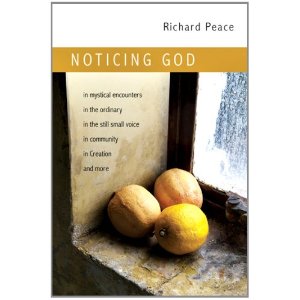
Just this morning I finished Dr. Richard Peace's new book, Noticing God. Here is my review.

The title of this book--Noticing God--suggests something astonishing to the average reader: That God is everywhere, and noticing him is a possibility.

Dr. Richard Peace takes a slippery and often miscommunicated topic--the awareness of God's presence and actions in the world--and makes it accessible, reasonable, and hopeful. While there are familiar tours through some classical spiritual disciplines and practices, Dr. Peace also recognizes that God sometimes appears to people in some very ordinary places, such as quiet voices, dreams, worship, and community.

This is no muddled journey through pantheism or foggy mysticism, but rather an embrace of the story of God's engagement with human beings through the narrative of Scripture, the accounts of saints throughout the ages, and experiences of contemporary pilgrims. Dr. Peace confesses his own cautions and concerns about claims made by some people (cautions and concerns that I share as well), and in doing so gives the reader permission to hold loosely to assertions about things God might or might not be doing in the world, and offers tools for processes of discernment within the Christian community.

One does not have to look far for books that tell stories of explosive encounters with God. Whether or not those stories are true, they can sometimes leave people with a sense of personal inadequacy, assuming that their own apparently meager (or non-existent) encounters with God cast them into second-class citizenship in God's kingdom. Dr. Peace heals that wound by considering the diverse and creative ways in which God reveals himself to people, and encourages even the most reluctant Christian mystic to open both eyes and ears to the possibilities of God's movement in both the dramatic and the ordinary.

This is a book designed for real people in real communities of faith. The exercises and questions at the back of the book offer valuable frameworks for group and individual engagement with the text, and also open the expectations of faith that anticipate a life that experiences the God of Abraham, Isaac, and Jacob--the one so supremely revealed in the person of Jesus Christ.

Friday, April 27, 2012

The Church, The State, and Care for the Poor


Rep. Paul Ryan’s recent speech at Georgetown University seems to have caused some of his Catholic brothers and sisters to take issue with Ryan’s budget proposal, viewing it as incompatible with Catholic teachings, especially in relation to care for the poor.

This brings up an interesting set of questions: Does the so-called “Separation of Church and State” doctrine prohibit such connections in the first place? Doesn’t that doctrine make the influences of any religious group unwelcome when it comes to the affairs of state? What is the church’s relationship to the state when it comes to topics like this?

First, as I understand it, the idea of separating church from the state was intended to prohibit the government from establishing a state religion. It was a clear reaction to the power of the Church of England, and the colonial framers of the US Constitution did not want to repeat what they considered to be an inappropriate alignment of power in Europe.

Second, to demand that any persons holding a place of governmental responsibility disallow their religious influences and values as they engage in the processes of policy-making is not reasonable. Whatever has formed a person—religious faith, past experiences, reason, education, and so on—will become part of the lens through which that person sees how things should work in the world. No one comes to the governmental table (or any table, for that matter) as a blank slate.

Having said this, I still have to wonder about the demands that religious groups—specifically Christians—can really make on the government. Certainly, in a culture based on individual rights, religious folks can makes all kinds of demands. But what is the place of Christian communities in the context of the nation?

That the church at large would call the state to act justly and fairly is a good thing. However, is it right that we would expect the state to act as though it is the church? Again, I’m all for the state being called to justice and fairness, but in the end isn’t it still appropriate that faithful communities of Jesus continue to enact the realities of the kingdom of God, regardless of the acts of the state?

In the CNN article about Rep. Ryan’s speech, a recent survey among American Catholics is cited that shows a decrease in concern for the poor. Could that be a result of the expectation that care for the poor is more a function of the state than it is a core expression of the church’s love for Jesus? If the state, even appropriately, enacts programs to care for the poor, does the church begin acquiesce its own identity in the world?

Thursday, April 19, 2012

Resolving the Evolution Question for Good


An NPR story (dated today, April 19, 2012) highlights the growing tension between evolutionary science and politics. However, to keep religion in the mix, I now share some personal family archival material that will put the matter to rest.

My great-grandfather, F. M. Lehman, was a traveling evangelist and hymn writer (he died when I was an infant, but I knew my great-grandmother well; she died at age 102, when I was 18). Among more well known songs, such as The Love of God, No Disappointment in heaven, and Old Time Religion, he also wrote major hits like King Nicotine Must Die, The Royal Telephone, and A String of Empties (I am not making this up).

One of my favorites was written in 1924, in an effort to put the emerging evolution controversy to rest. Here are the words to Up a Cocoanut Tree:

The “wise and prudent” tell me just what once I used to be—
A “germ” and then “tadpole;” then a “monkey up a tree.
But just because a cocoanut fell on their poor old head
Should be no reason I believe what disbelief has said.

A monkey never yet evolved to be a real man,
But man can be a monkey, just deny it if you can.
If on their head there fell a nut dropt from a cocoa tree,
I’m sure that that shall never make a monkey man of me.

Some ignoramus of the schools in mortorboard and gown
Declares this “monkey” business has been ably sifted down.
He guessed because a cocoanut fell on his hollow head
That evolution must be true; that Christ the Lord is dead.

Chorus:

They’re guessing! Just guessing—only guessing!
God made you and me. We’re no relation to the monkey up a cocoanut tree.


© Kansas City MO: Lillenas Publishing Company, 1952