Showing posts with label politics. Show all posts

Tuesday, June 25, 2013

Ordinary Time - Jesus and Reorientation


Jesus went throughout Galilee, teaching in their synagogues and proclaiming the good news of the kingdom and curing every disease and every sickness among the people. So his fame spread throughout all Syria, and they brought to him all the sick, those who were afflicted with various diseases and pains, demoniacs, epileptics, and paralytics, and he cured them. And great crowds followed him from Galilee, the Decapolis, Jerusalem, Judea, and from beyond the Jordan.
When Jesus saw the crowds, he went up the mountain; and after he sat down, his disciples came to him. Then he began to speak, and taught them . . . (Matthew 4:23-5:2)


For me, the gospeller Matthew is a master storyteller. My imagination opens up when I read Matthew’s account of Jesus, and I see in my mind the story as it comes to life, hopefully in a way that comes sort of close to where the author intended.

In the passage just before the one above, Jesus goes around making new friends and inviting them to journey with him—to follow him. Then, he immediately draws them into the work he has come to do—proclaiming the good news of God’s kingdom and healing the sick, both of which were signs of God’s present and future intentions for the world.

Once he sees crowds of people responding to his work (and why wouldn’t they?), he heads up the side of a mountain and his friends follow him there. At first it seems like a very private meeting, one that is separated from the drama of the crowds below, but then you get to the end of chapter seven and you find out that the people were all astonished at his teachings. Apparently Jesus’ words weren’t limited to just his twelve new friends. Maybe the side of the mountain served as his pulpit as he spoke to the crowds as they gathered below.

The words that Jesus speaks in the text that follows—what we call The Sermon on the Mount—are a message of reorientation. He knows that the people, by and large, come with a preset way of thinking about life, human relationships, God, justice, and so on, but that their mental lenses for looking at reality are flawed, marred by legalism, guilt, shame, misinterpretation, and tribal preferences. So he does quite of bit of “You have heard . . .” contrasted by “But I say to you . . .” stuff in his sermon.

This is kind of like what happened to the ancient Hebrew people when God, through Moses, rescued them from the Pharaoh’s grasp. They had spent generations as slaves in Egypt, and their identity was completely wrapped up in that categorization. When they are given the Law—not just the Ten Commandments, but the entire Levitical code with all of its rules about dietary restrictions, social relationships, worship, and justice—they find a new way to live together that is oriented toward God rather than toward Pharaoh, and it brings life to them.

But by Jesus’ day, that liberating, reorienting Law had become soul-breaking legalism, and he brings a fresh word to the people, revealing God’s intentions as they always had been. This is not a new kind of law that Jesus brings; it is a new and life-giving way to orient one’s life toward God.

I think that we who claim to follow Jesus need to revisit this business of reorientation every so often. I know that I do. It’s easy to get smug and decide that we’ve pretty much got things figured out and then quit thinking too deeply about whether we’re right or not. I think we need to hear Jesus say, “You have heard . . . but I say to you . . .” once in a while so that we remember that our confidence doesn’t come from getting everything right, but rather that it comes from following close to Jesus.

There are a lot of issues right now tearing the Christian church to pieces—like the place of gay people in the life of the church, immigration reform, economic justice, and how we closely we align our faith with our political preferences. Most of us engage in these conversations with perceptions of rightness that come out of our personal histories. We have made past decisions, we’ve studied, we’ve argued, and we’ve heard. We often believe that we’ve got it all right.

But maybe these difficult conversations are an opportunity for us to listen anew to the voice of Jesus say,

“But I say to you . . .”

And we might be astonished.

Thursday, April 11, 2013

Mainstream Heresy


It’s funny how something considered to be heresy at one time can become acceptable and commonplace at another.

I was raised up in a denomination that had the word “Pentecostal” in its name when it was formed well over a hundred years ago. It dropped that word because the people didn’t want to have any connection whatsoever with the new, emerging Pentecostal movement that was clearly heretical.

Years later I joined up with a new Christian movement that worshipped (in song) for a long time before any preaching or teaching took place—hands in the air, eyes closed, people acting like they loved God and God was loving them back. There were a lot of claims back then that we were all just “worshipping worship” (whatever that means) and were all heretics.

A friend of mine was sure that one of the more prominent spokespersons for the movement known as Emergent was a heretic because the person apparently didn’t believe that penal substitution and propitiation were the only possible ways to talk about what God had done in and through the person of Jesus Christ. I had to tell my friend that I didn’t believe that way either. He realized that he was having breakfast with a heretic.

Pentecostals, of course, are now a worldwide movement of Christians and are accepted and respected as vital members of the body of Christ. People in mainline and sacramental churches often raise their hands in worship, closing their eyes in focused adoration of God. Respected biblical scholars and theologians increasingly recognize that the atonement is more like a multi-faceted gem than a single metaphor hardened into concrete.

There are still people out there who blog, tweet, and Facebook their convictions that certain people are heretics. So when N. T. Wright claims that Paul was saying something more expansive in Romans than we’d thought before, some said he was a heretic. When Rob Bell asked questions regarding our uncritical acceptance about who is in and who is out with God, suggesting that God’s love is more generous than we’ve allowed, he was branded a heretic. Years ago, when Clark Pinnock jumped into the conversation that challenged the traditional view of God’s impassability and entertained the idea of open theism, he was brought up on heresy charges and threatened with dismissal from a major evangelical scholars’ group.

There is a theory about how human beings process new information called cognitive dissonance. I think it goes this way: When a new idea is presented that challenges a person’s long-standing belief, tension is created between the old idea and the possibility of the new idea that the person seeks to resolve. Resolution can happen in at least three ways:

1. The old idea is re-embraced and the old idea is immediately discarded, simply on the basis of it being new.
2. The new idea is analyzed, but only for the purpose of creating a defense that will validate the superiority of the old idea.
3. The new idea is analyzed and given consideration, and allowed to inform and possibly modify the old idea.

It seems to me that much of our labeling of ideas as heretical is a result of numbers one and two. It’s not always heresy that we’re dealing with—it’s our own cognitive dissonance. It’s our attempt to relieve the tension created when a new idea collides with our old ideas. There’s a big difference between considering multiple biblical metaphors that seek to describe the atonement, and the claim that Jesus didn’t really suffer and die on the cross.

I wonder if the constant heresy claims, given platforms through various forms of social media and providing to some vocal public figures the basis for their mission in the world, are a reflection of the deep polarization that characterizes the US today. Our politicians speak of each other as though they are all axe murderers; our political parties seal themselves off in their fortresses and refuse to work together for the good of the nation; Christian leaders run to the microphone too quickly to condemn others, claiming to clearly know that they are always in the right.

We need to work on this. Are we a people who can learn to embrace civility, to have listening ears before we have accusing mouths, to love before and after we debate? Is it possible that we could become a people that would be a light to the world, the salt of the earth?

That’s an idea I heard from a heretic.

Tuesday, May 15, 2012

Is Jesus Reckless?

In reading Luke chapter nine this morning, I was struck by the way Jesus seemed to play a bit fast and loose with the qualifications for joining him in his work. We know that the twelve disciples were pretty sketchy in their understanding of who Jesus was and what he was up to, yet they were sent out in his authority to proclaim the good news of the kingdom, to heal the sick, and to cast out demons. And Jesus sent them out unsupervised!

On top of that, when he was told that someone was out there casting out demons but not as part of the group of disciples, Jesus told his friends that it was okay: If a person isn’t against you, he says, then consider yourselves on the same team.

But what if (I am thinking to myself) that other person doesn’t think rightly about things we consider to be important? James might be wondering, “What if that person thinks that Samaritans are just as good as Jews?” John might ask, “What if that person is like the Sadducees, and doesn’t believe in the resurrection of the dead?” Peter could be asking, “But what if that person hasn’t given up everything like we have?”

If the disciples were to have asked Jesus these kinds of questions, there’s a good chance he would have answered them like he answered Peter much later, described in John 21:22:

“What is that to you? Follow me.”

I wonder if, today, Jesus wanders through the halls of power, up and down the grimy streets of the city, along the corridors of the prisons and the sanctuaries, seeing people acting out their dramas as ones who are sometimes for him and sometimes against him. In those places of turmoil and intrigue, does he continue to whisper the same words over and over to all the broken and misguided people he encounters?

“Come, follow me.”

And when we who call ourselves faithful describe who is in and who is out, whose political posturing constitutes good or evil, whose doctrinal declarations are truthful or heretical, whose worship practices are valid or invalid, does Jesus continue to say to us,

“What is that to you? Follow me.”

Thursday, April 19, 2012

Resolving the Evolution Question for Good


An NPR story (dated today, April 19, 2012) highlights the growing tension between evolutionary science and politics. However, to keep religion in the mix, I now share some personal family archival material that will put the matter to rest.

My great-grandfather, F. M. Lehman, was a traveling evangelist and hymn writer (he died when I was an infant, but I knew my great-grandmother well; she died at age 102, when I was 18). Among more well known songs, such as The Love of God, No Disappointment in heaven, and Old Time Religion, he also wrote major hits like King Nicotine Must Die, The Royal Telephone, and A String of Empties (I am not making this up).

One of my favorites was written in 1924, in an effort to put the emerging evolution controversy to rest. Here are the words to Up a Cocoanut Tree:

The “wise and prudent” tell me just what once I used to be—
A “germ” and then “tadpole;” then a “monkey up a tree.
But just because a cocoanut fell on their poor old head
Should be no reason I believe what disbelief has said.

A monkey never yet evolved to be a real man,
But man can be a monkey, just deny it if you can.
If on their head there fell a nut dropt from a cocoa tree,
I’m sure that that shall never make a monkey man of me.

Some ignoramus of the schools in mortorboard and gown
Declares this “monkey” business has been ably sifted down.
He guessed because a cocoanut fell on his hollow head
That evolution must be true; that Christ the Lord is dead.

Chorus:

They’re guessing! Just guessing—only guessing!
God made you and me. We’re no relation to the monkey up a cocoanut tree.


© Kansas City MO: Lillenas Publishing Company, 1952

Wednesday, April 11, 2012

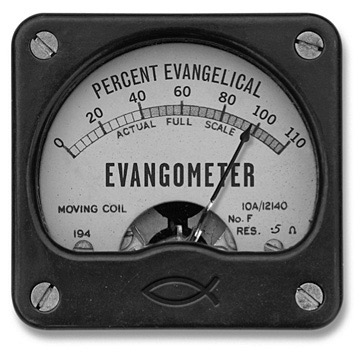
Evangelicals Need a New Definition


And maybe even a new name.

I once asked a group of Catholic friends how they defined the term evangelical, and they saw it as identical to fundamentalist. Each one had a story of an evangelical cousin or uncle who hammered them at every family gathering, insisting that Catholics were on a sure pathway to Hell. For these folks, evangelical brought up descriptors such as judgmental, condemning, and mean.

If I’m reading the political pundits correctly, evangelical is a term that refers to a block of USAmerican voters that conflates nation and religion, lining up with the extreme right of the political spectrum. Evangelicals appear to hold a great deal of power in making or breaking particular political campaigns.

I’ve heard others say that evangelicals are the folks who hold to a wooden and hyper-literal view of all aspects of the Bible, see the theory of penal substitutionary atonement as a theological hill to die on, and have a clear understanding of who is in and who is out with God.

I am saddened by what I see in these descriptors. If these are what define evangelical, then I don’t want to be one.

But none of these are proper definitions of the word. The word evangelical comes from a Greek word (used in the New Testament) that means good news. When Jesus, in Mark 1:15 says, “The time is fulfilled, and the kingdom of God has come near; repent, and believe in the good news,” the term “good news” utilizes that Greek word.

It’s actually an ancient term with military implications. After a battle, a runner would leave the front lines and bring news of the outcome to the military leaders. If the battle had been won, then it was good news. The messenger was the good news bringer. The messenger was the person who bore witness to the good thing that had happened.

This meaning is at the heart of the word that we now call evangelical. To be evangelical is to be the bearer of the same good news that Jesus brought: That the kingdom of God is at hand. It is to speak of a reality that has already come to pass. Keeping in mind that those folks who don’t like the idea of God’s rule and reign (perhaps like the army who lost the ancient battle) might not hear the message as good news, it is proclaimed nonetheless because it is believed by the messenger to be true.

The message granted to us is not one of political power or domination; it is not about who has been assigned to heaven or to hell; it is not license to stand in judgment over anyone. It is a message that is intended for the good of all, and it is one to be both proclaimed and demonstrated.

If the earlier definitions I offered hold sway, then I suggest we find a different word with a proper definition. It would be a shame to lose a word that is rich with meaning and purpose, but it might have to happen. There is some biblical precedent for such a change: The ancient Hebrews became Jews; the followers of The Way became Christians. It has happened before.

I don’t have a replacement term. But maybe one might emerge if we Christians, rather than being known by our political preferences, or by our tendency toward judgmentalism, or by our rigid theologies, we were known by our love. I wonder what would happen then. Maybe those who are impacted by that love would hear that good news and offer a new name to us.

Let’s give it a shot.

Tuesday, April 10, 2012

Taking the Candidates' Religious Temperature


There is more news these days about why evangelicals should be wary of voting for Mitt Romney. The basis of this wariness is found in the doctrinal differences between Mormons and Christians (the fact that Mormon’s consider themselves to be Christians notwithstanding).

Clearly there are doctrines and teachings that separate Evangelicals from Mormons, such as, for example, the doctrine of God as Trinity—Father, Son and Holy Spirit. Mormons don’t believe in the Trinity. Of course, neither do Jewish people. So does that mean that Evangelicals should not vote for someone who is Jewish? Don’t our divergent views about Jesus cause us problems here?

But a Roman Catholic, like John F. Kennedy or Rick Santorum, would be okay, right? After all, they are committed to Trinitarian theology and the divinity of Jesus. Oh, but wait: There’s all that other stuff about saints and papal authority and transubstantiation. Those are all things that Evangelicals in general do not endorse.

For Evangelical voters, is doctrinal correctness (however that might be defined) the litmus test for presidential suitability? In the USA it is legal to be affiliated with any religious group that one desires. People are free to be Evangelical, Roman Catholic, Eastern Orthodox, Hindu, Buddhist, Muslim (yes, even Muslim) or of any other religious persuasion. We have this whole freedom of religion thing going for us, and I’m glad for that.

This freedom also means that a presidential candidate can be any or none of those things. While the USA probably wouldn’t elect an outspoken atheist to the presidency any time in the near future, it is not illegal for a candidate to disbelieve in God.

I wonder if, rather than asking about how a candidate’s religious faith (or lack of it) lines up with a certain brand of orthodoxy, we should be asking how that faith (or lack of it) informs their view of the world and the way they make decisions. Does a candidate’s religious orientation produce the kind of leadership that serves a huge and diverse nation like the USA? Does the candidate find an ethical and moral basis in a life of faith that gives voters confidence in the way that decisions will be made and how this country will engage with the rest of the world?

While our candidates typically enter office as Democrats or Republicans, once elected they must serve the entire nation and not just members of the party that elected them. Would a Mormon or Catholic or Jewish or Muslim president be able to serve the entire nation, or just adherents to that president’s preferred faith tradition? Would such a president be a leader to all, or just to a select few?

I think that we are often asking the wrong questions. Are we asking about a candidate’s faith because we want to know how our particular interest group will be served, or because we want to know how that nation at large will be served? Are our questions about acquiring a political power base for ourselves, or about the well-being of our neighbor?

The wrong answer to the questions would be that faith doesn’t matter, or that it can be set aside as though it is irrelevant to leadership. Of course it matters, and of course it forms people at a very deep level. How that faith produces a leader who can lead well is what we should try to discover.

Saturday, March 31, 2012

The Industry of Politics

Every time there is a presidential election, I find myself wondering about all the accusations that the candidates make about one another, and especially about those directed at the incumbent President. If these things were all true, then standing Presidents would be regularly impeached, and competing candidates would be either imprisoned or hanged.

The ironic thing about the process is that, after vilifying one another in the debates, the candidates smile, shake hands, and maybe even go out for beers. After the election, the loser calls up the winner and offers congratulations. The police are not sent out to make arrests and public executions do not follow each election.

And yet, we of the general populous take all this stuff very seriously. We believe what we hear, especially when it props up what we already believe. We call that legitimate Patriotism. In the religious world, we have a corollary term: Heresy, which generally means telling someone something about their faith that they don't already know.

So elections become more about image, combativeness, and marketing rather than about leadership, integrity, and vision. James Davison Hunter, in his fine book To Change the World: The Irony, Tragedy, and Possibility of Christianity in the Late Modern World, describes it this way:

"[Electoral politics] has become an industry oriented far more toward the management of images and the marketing of a candidate than to the propagation of political ideals and policies." (p. 39)

What do you think? Is this true?

Thursday, March 29, 2012

Speaking the Truth, Even in an Election Year

Recently I saw a post on Facebook that showed the image of a poster with Rick Santorum's face on it. Next to him was a quote that was caustic, stupid, and hateful, by anyone's standards. Most of the comments added to the post expressed their horror at the statement.

It was so far out there that I couldn't help but go to Snopes to see if it was a fabrication, and it was. To the FB person's credit, he removed the post promptly and apologized for the error in judgment. I appreciated his attitude.

During the last election, I also saw such postings, via FB and through email, from Christians who didn't like Barack Obama. A number of these things turned out to be false (or at least out-of-context editings) as well.

I know that it's virtually impossible to control this kind of thing. However, I would encourage my Christian brothers and sisters—regardless of your political preferences—to avoid bearing false witness, even if it supports your position. Applauding and reproducing a falsehood is simply wrong, and we should not do it. If the candidate we do not prefer is being falsely accused, then we should be the ones who cry out for justice.

We can do that, right?

Wednesday, October 8, 2008

Election Time Sorrow

Elections do not make me sorrowful--irritable and outraged, yes--but not sorrowful. I've come to expect that campaigns make a great deal of noise and then someone ultimately has to go to work and do something. 

What does bring me sorrow is watching how too many people in the Christian community use the Internet to pass on questionable and even slanderous information about particular candidates. I've seen doctored videos, scandalous urban legends and contextless photographs suggesting abominable behaviors, many sent by people claiming to follow Jesus.

I do believe that these people love Jesus. But I fear that some have equated faithfulness to the gospel with embracing the agendas of one political party over another. If one sees the political process as kind of war, then perhaps the thinking might be that any explosive device is permissible.

But I claim that it is not. 

Passing on via email some of the things I've seen looks like bearing false witness to me. I wonder how we square these activities with Jesus' call to love our enemies and pray for those who persecute us (although few of us in the US know anything about persecution, and many of our enemies are those of our own making). 

Scott McKnight (jesuscreed.org) offers some fine ruminations about the election. I appreciate that he affirms our role as Christians to be as ones seeking the kingdom of God first, and not expecting candidates, parties or governments to be what only God and his kingdom can be.

I believe that participation by Christians in the political process is important in the same way that our overall engagement with the world is important. Remember that Israel preferred the politics and military mechanisms of the surrounding nations to leadership under the hand of God, and paid dearly for that choice. We must remind ourselves that our role is to be God's people, not for our own sake or for the sake of a particular national agenda, but rather for the sake of the world.