Showing posts with label Jews. Show all posts

Wednesday, February 27, 2013

A Lenten Reflection for February 27, 2013


And since they did not see fit to acknowledge God, God gave them up to a debased mind and to things that should not be done. They were filled with every kind of wickedness, evil, covetousness, malice. Full of envy, murder, strife, deceit, craftiness, they are gossips, slanderers, God-haters, insolent, haughty, boastful, inventors of evil, rebellious toward parents, foolish, faithless, heartless, ruthless. They know God’s decree, that those who practice such things deserve to die—yet they not only do them but even applaud others who practice them.
Therefore you have no excuse, whoever you are, when you judge others; for in passing judgment on another you condemn yourself, because you, the judge, are doing the very same things. (Romans 1:28-2:1)

Let your steadfast love become my comfort according to your promise to your servant.
Let your mercy come to me, that I may live. (Psalm 119:76-77)


It’s very helpful to have those people around. You know the ones—they’re responsible for doing all the bad things that we hear about. They provide us with the opportunity to objectify evil so that we know it’s out there with those people. That way we can be secure in the knowledge that it’s not in here with us.

But it is.

The apostle Paul was writing to help Jewish and Gentile Christians figure out how to live together, to be one body in Christ. In doing so, he leveled the moral playing field by making everyone culpable in acts of wickedness. Jesus did this too:

“You have heard that it was said, ‘You shall not commit adultery.’ But I say to you that everyone who looks at a woman with lust has already committed adultery with her in his heart.” (Matthew 5:27-28)

The mind is tethered to the hand. I may not have committed adultery, but I have shared the same mind with the adulterer. I may not have committed murder, but in my anger I have opened the possibility of such an action. We’re not so far apart, those people and me.

I take comfort in remembering that, in Jesus . . . “we have one who in every respect has been tested as we are, yet without sin. Let us therefore approach the throne of grace with boldness, so that we may receive mercy and find grace to help in time of need” (Hebrews 4:15b-16).

I can’t really think about those people without recognizing that I am kin to them. But the recognition is important. It motivates me to turn to God, who, in the person of Jesus, has entered into the entirety of human existence. In that turning he rightly judges my life and draws me into a life that is new.

Just as he desires to do for those people.

Wednesday, April 11, 2012

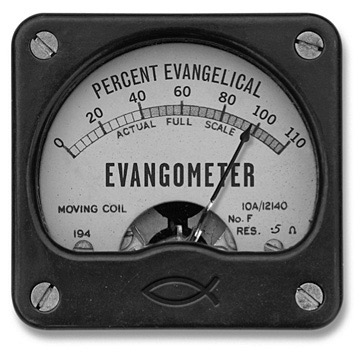
Evangelicals Need a New Definition


And maybe even a new name.

I once asked a group of Catholic friends how they defined the term evangelical, and they saw it as identical to fundamentalist. Each one had a story of an evangelical cousin or uncle who hammered them at every family gathering, insisting that Catholics were on a sure pathway to Hell. For these folks, evangelical brought up descriptors such as judgmental, condemning, and mean.

If I’m reading the political pundits correctly, evangelical is a term that refers to a block of USAmerican voters that conflates nation and religion, lining up with the extreme right of the political spectrum. Evangelicals appear to hold a great deal of power in making or breaking particular political campaigns.

I’ve heard others say that evangelicals are the folks who hold to a wooden and hyper-literal view of all aspects of the Bible, see the theory of penal substitutionary atonement as a theological hill to die on, and have a clear understanding of who is in and who is out with God.

I am saddened by what I see in these descriptors. If these are what define evangelical, then I don’t want to be one.

But none of these are proper definitions of the word. The word evangelical comes from a Greek word (used in the New Testament) that means good news. When Jesus, in Mark 1:15 says, “The time is fulfilled, and the kingdom of God has come near; repent, and believe in the good news,” the term “good news” utilizes that Greek word.

It’s actually an ancient term with military implications. After a battle, a runner would leave the front lines and bring news of the outcome to the military leaders. If the battle had been won, then it was good news. The messenger was the good news bringer. The messenger was the person who bore witness to the good thing that had happened.

This meaning is at the heart of the word that we now call evangelical. To be evangelical is to be the bearer of the same good news that Jesus brought: That the kingdom of God is at hand. It is to speak of a reality that has already come to pass. Keeping in mind that those folks who don’t like the idea of God’s rule and reign (perhaps like the army who lost the ancient battle) might not hear the message as good news, it is proclaimed nonetheless because it is believed by the messenger to be true.

The message granted to us is not one of political power or domination; it is not about who has been assigned to heaven or to hell; it is not license to stand in judgment over anyone. It is a message that is intended for the good of all, and it is one to be both proclaimed and demonstrated.

If the earlier definitions I offered hold sway, then I suggest we find a different word with a proper definition. It would be a shame to lose a word that is rich with meaning and purpose, but it might have to happen. There is some biblical precedent for such a change: The ancient Hebrews became Jews; the followers of The Way became Christians. It has happened before.

I don’t have a replacement term. But maybe one might emerge if we Christians, rather than being known by our political preferences, or by our tendency toward judgmentalism, or by our rigid theologies, we were known by our love. I wonder what would happen then. Maybe those who are impacted by that love would hear that good news and offer a new name to us.

Let’s give it a shot.

Tuesday, March 13, 2012

Where was God?

I stood yesterday over the huge bin of shoes, the smell of old leather hanging in the air like a dim memory. A young woman standing near me was weeping. I saw a small shoe among the thousands that the Nazis took from the Jews. It looked about the size that one of my grandsons wears.

The Holocaust Museum in Washington DC provides visitors with a startling, heart-breaking experience. That such a horrific series of evil events could occur in recent history is almost unthinkable, but the museum refuses to let the story die.

People have to ask, after witnessing the accounts of the genocides of World War II: "Where was God?" I asked it a number of times myself. But it occured to me that maybe God was doing what he always does--calling the church and the world to enact his justice, to rescue the oppressed.

Maybe too many weren't listening. Many German leaders--leaders in both the church and the state--listened to Hitler, but not to God. Nations--including the US--shut their ears and refused to take in the persecuted strangers, allowing immigration limits to trump the call to alleviate human suffering and to provide care for the stranger.

Others, however, did listen. Denmark protected its Jewish citizens from Nazi demands. The Dominican Republic took in 100,000 Jewish refugess. Faithful Christians and people of good conscience protected as many as they could, often suffering harsh consequences for their courageous acts of rescue.

I believe that God was at work during that dark time in world history, not only suffering with the oppressed, but also calling out for people to stop the machinery of terror and rescue those targeted by Hitler's insane, murderous schemes.

I wonder what our ears are closed to right now? I wonder what my ears . . .