Showing posts with label heaven. Show all posts

Thursday, April 18, 2013

Hell in Proximity to God


When I think of Hell, I don’t think of a fiery place where people are being tormented by the devil (or by someone else, since Revelation 20 dispatches him). In fact, I don’t really think of a place at all. I think of proximity. Proximity to God.

I imagine all kinds of people on the other side of death. There are folks playing, laughing, luxuriating in the joy of God’s presence. Others are staring off in the distance in wonder, marveling at the recognition that God has embraced them at all. But a good time is being had by all (granted, I’ve not explored whether this is post-physical resurrection or not, but I’m doing art right now, not science).

There are, however, others in this scene. They are turned, not so much away from God as they are turned into themselves. There are those who are still demanding their rights—including the right to dislike or deny God—and they are oblivious to the joy that surrounds them. There are genocidal maniacs, like the aforementioned Hitler, who are screaming their rabid rants into an airspace where only they can hear their own, constant vitriol, while some of their victims come along and lay flowers at their feet, hoping that just for a moment, they might just look around see the possibilities that eternity holds.

These are shadow people, who stand in their own private spheres of darkness. They are seen by the others, but they see no one but themselves. There is also something wrong with them—parts of their bodies are burned away, the result of the persistent light of God that is life to many, but continues to act as a surgical fire to those in the shadows, slowly burning away the evil. For some, there may soon be nothing left.

Some of those are people of various religious groups who, having met Jesus in this place for the first time, realize he is the one they had always been looking for. Some of these are the wondrous gazers, who are stunned by God’s generous love.

Every so often one of the shadow people, having stood in isolated darkness for the equivalent of months or years or centuries, looks around suddenly and realizes that what they had staked their life on was not worth it all. As they face the light, their fractured bodies begin to slowly heal, and they become real for the first time.

Jesus wanders from person to person, participating in the joy that is expressed by so many. He also stops at each shadow person, laying a hand on a shoulder, not troubled by those who shrug away, the tears on his face evidence of his love for even the most broken of them. Once in a while one of them shudders and looks him in the eye, recognizing him at last and breaking into wracking sobs. Jesus embraces that one and leads the person out of that cobwebby space and into the freshness of eternity. His tears flow anew as the person’s body is reknitted into wholeness.

Okay, so I know there is no direct mention of sheep and goats, outer darkness, gnashing of teeth, or any other biblical image of judgment. But if Paul was right, and “in Christ, God was reconciling the world to himself, not counting their trespasses against them,” then there might be something to think about in my fanciful story. Maybe all will stand forever in proximity to God. For some, it will be life. For others, darkness and decay.

But does it end there? Well, not to worry. It’s only a story.

Wednesday, April 17, 2013

What the Hell?


The artist has to ask questions in order to create. It is from the questions that the creative life emerges. Artists ask themselves what if questions, and then proceed to ask everyone else if what has come out of their questioning is really art.

Writers of fiction do this all the time. C. S. Lewis asked what God’s reconciling work would look like in a land populated by mythic creatures, and produced The Chronicles of Narnia. Stephen King asked what kind of world people would create if most of the human population was wiped out by a plague, and produced The Stand.

It occurs to me that some of the folks in the Christian world who take a great deal of heat are the ones who ask some difficult what if questions, like: What if God’s love is broader and more generous than we’ve imagined? Or, What if our dominant views about the atonement are limited and not really true to our scriptures? They usually start by asking themselves those kinds of question, and then they ask the rest of us, “What do you think—is this Christianity?”

One of the questions that always intrigue me is about Hell. Suggesting that our traditional views about Hell could be flawed usually creates a firestorm of outrage. People ask if God really assigns both the genocidal maniac and the nominal slob who never amounted to much to the eternal and fiery tortures of Hell, and some folks respond as though the idea of countless multitudes screaming in agony forever is comforting.

The late Fr. Richard John Neuhaus once said something to the effect of, “It’s not that I don’t believe in Hell. It’s just that I don’t want anyone to be there.”

The idea of Hell—at least, the idea of Hell as a tortuous place created to take in all who deserve to go there—has its problems. First of all, the Bible doesn’t speak with a singular voice about Hell. There are multiple images related to where dead people go: Sheol, Hades, Gehenna. We are even told in The Apostles’ Creed that Jesus “descended to the dead” (some versions say “Hell”), causing us wonder what he did while he was there.

But, secondly, we struggle with some other problems as well. Since, according to Revelation 20:10, the devil ends up being tossed into the lake of fire and is tormented forever, we have to wonder: So who torments everyone else? Is it God who receives the worship of the faithful dead with one hand, and stokes the fires of Hell with the other? And he does this forever?

And we’re not really sure what it is that qualifies us for Hell. Is it our behavior, or our belief?

Here’s an example: The 20th century poster boy for pure, maniacal evil is Adolf Hitler, most folks would agree, and we would consign him to the most distant and painful corner of Hell available. But what if, just before he died (and if his girlfriend shot him in the head rather than Hitler committing suicide, just to keep things simple), he repented of his great transgressions and asked God to forgive him and then put his trust in Jesus? Wouldn’t he now be in heaven with all the saints and angels? I suspect that most Evangelicals would vote yes on that.

But if right belief is the ticket to Heaven, then wouldn’t the six million Jews that died as Hitler’s command be languishing in Hell? After all, their belief system would probably not include Jesus. So, really, based on that thinking, we can’t condemn Hitler to Hell for his actions, only for his lack of belief.

I understand that not all people, including Evangelical Christian people, would think that things worked that way. However, the questions should still be asked, and it is, in my view, the vocation of theological artists to do the asking. And when the artists ask everyone else, “What do you think—is this Christian?” we should all stop and say, “Well, I’m not sure. But maybe we should go back and check things out.”

The artist might be wrong, and answer to the question might occasionally be “no.” But the mere act of asking, when the question runs cross-grain to traditional thinking, should not result in a heresy trial.

And if someone asks if there really is a Hell, and even if we believe there is, our response ought to be a tearful one that says, “Yes, but I do wish it wasn’t so.”

Wednesday, April 11, 2012

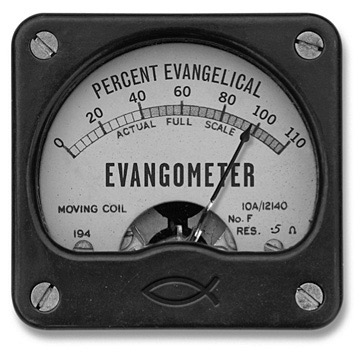
Evangelicals Need a New Definition


And maybe even a new name.

I once asked a group of Catholic friends how they defined the term evangelical, and they saw it as identical to fundamentalist. Each one had a story of an evangelical cousin or uncle who hammered them at every family gathering, insisting that Catholics were on a sure pathway to Hell. For these folks, evangelical brought up descriptors such as judgmental, condemning, and mean.

If I’m reading the political pundits correctly, evangelical is a term that refers to a block of USAmerican voters that conflates nation and religion, lining up with the extreme right of the political spectrum. Evangelicals appear to hold a great deal of power in making or breaking particular political campaigns.

I’ve heard others say that evangelicals are the folks who hold to a wooden and hyper-literal view of all aspects of the Bible, see the theory of penal substitutionary atonement as a theological hill to die on, and have a clear understanding of who is in and who is out with God.

I am saddened by what I see in these descriptors. If these are what define evangelical, then I don’t want to be one.

But none of these are proper definitions of the word. The word evangelical comes from a Greek word (used in the New Testament) that means good news. When Jesus, in Mark 1:15 says, “The time is fulfilled, and the kingdom of God has come near; repent, and believe in the good news,” the term “good news” utilizes that Greek word.

It’s actually an ancient term with military implications. After a battle, a runner would leave the front lines and bring news of the outcome to the military leaders. If the battle had been won, then it was good news. The messenger was the good news bringer. The messenger was the person who bore witness to the good thing that had happened.

This meaning is at the heart of the word that we now call evangelical. To be evangelical is to be the bearer of the same good news that Jesus brought: That the kingdom of God is at hand. It is to speak of a reality that has already come to pass. Keeping in mind that those folks who don’t like the idea of God’s rule and reign (perhaps like the army who lost the ancient battle) might not hear the message as good news, it is proclaimed nonetheless because it is believed by the messenger to be true.

The message granted to us is not one of political power or domination; it is not about who has been assigned to heaven or to hell; it is not license to stand in judgment over anyone. It is a message that is intended for the good of all, and it is one to be both proclaimed and demonstrated.

If the earlier definitions I offered hold sway, then I suggest we find a different word with a proper definition. It would be a shame to lose a word that is rich with meaning and purpose, but it might have to happen. There is some biblical precedent for such a change: The ancient Hebrews became Jews; the followers of The Way became Christians. It has happened before.

I don’t have a replacement term. But maybe one might emerge if we Christians, rather than being known by our political preferences, or by our tendency toward judgmentalism, or by our rigid theologies, we were known by our love. I wonder what would happen then. Maybe those who are impacted by that love would hear that good news and offer a new name to us.

Let’s give it a shot.

Monday, March 26, 2012

The Doctrine of Election Questioned


I’ve always struggled with the theological concept of election. As it was often presented to me, it described how God has elected, or chosen, some to be saved and live eternally with him in heaven, and elected others to suffer eternally in Hell. I know the doctrine has a long history, but it still has always given me fits. It made the unfortunate ones who were excluded from God’s favor seem like the human presto-logs that were needed to keep the fires of Hell stoked.

Theologians and biblical scholars like Lesslie Newbigin, Gerhard Lohfink, Christopher Wright, and others have helped me with this. They frame the idea of election, not as God’s way of excluding some over others, but rather the election of the few for the sake of the world.

Israel is God’s elect, gathered to be his own people through whom, all the families of the world would find blessing (Genesis 12:1-2). Israel came to into existence for the sake of the world.

Jesus is God’s elect, and through him God is reconciling the world to himself, not counting their trespasses against them (2 Corinthians 5). Jesus was born, lived, suffered, died, and rose from the grave for the sake of the world.

Those who follow and trust Jesus are also gathered as God’s elect, not for their own sake, but for the sake of the world that God loves and is reconciling to himself. We participate in God’s mission for the sake of the world.

I know that different faith traditions have other views of election. However, there is, in my view, a problem with the idea that God would simultaneously love the world and yet pre-condemn the majority of human beings to eternal suffering and torment. I don’t see that the larger narrative of scripture supports that view.

The ability and freedom for people to receive or reject God’s love is a human prerogative rather than a divine imperative.

Friday, March 2, 2012

Learning from Mormons

I read an article this morning about the late Daniel Pearl's baptism-by-proxy, performed by some Mormons in Idaho. I knew that baptism of the dead was a common practice by Mormons, but I never knew what was behind it.

It appears, at least according to this article, that their goal is that all people will be redeemed. Saved. So they baptize the dead—even non-Mormons like Daniel Pearl—so that the world might be saved.

While I'm not advocating for Mormon doctrines, I am intrigued by this. Evangelicals preach the gospel so that some will be saved (depending on how they view things like election, predestination, and God's mission in the world). Mormons baptize the dead so that all will be saved. I guess they figure that as long as they keep up the family research work that they do and respond to the requests to baptize the dead, they'll always be in that business.

Maybe there is something for we evangelicals to learn here. We too often draw sharp lines about who is in and who is out, as if we have laid claim to the guest register at Hotel Heaven. We've created very precise requirements about what makes a person acceptable to God (we say that it's faith in Jesus, but we sometimes include the accuracy of the confession, doctrinal affirmations, and even political preferences in the mix). The Mormons don't seem too concerned about those kinds of things. They just baptize the dead willy-nilly, with the intent of helping them live forever in the place of God's intention. So maybe it's a practice that people like me don't buy, but there's still something behind it worth considering.

And it isn't universalism, just so you know. Unless we're talking about the universal nature of God's love, and the universal reach of his mission in the world, and the universal call for the people of God to bring blessing to all the families of the earth (Genesis 12:1-2). That's the kind of universalism I can affirm.

I'm not particularly interested in baptizing the dead, but like Daniel Pearl's mother graciously commented, I think that the Mormons have good intentions. Perhaps we might learn that we can baptize the living with love, prayer, blessing, care, service, hope, and direction. We should certainly preach the gospel, but not absent of demonstration. The evidence of the kingdom of God's present reality is seen in people and communities of faith that demonstrate the reality of the kingdom.

We need to express our own good intentions.